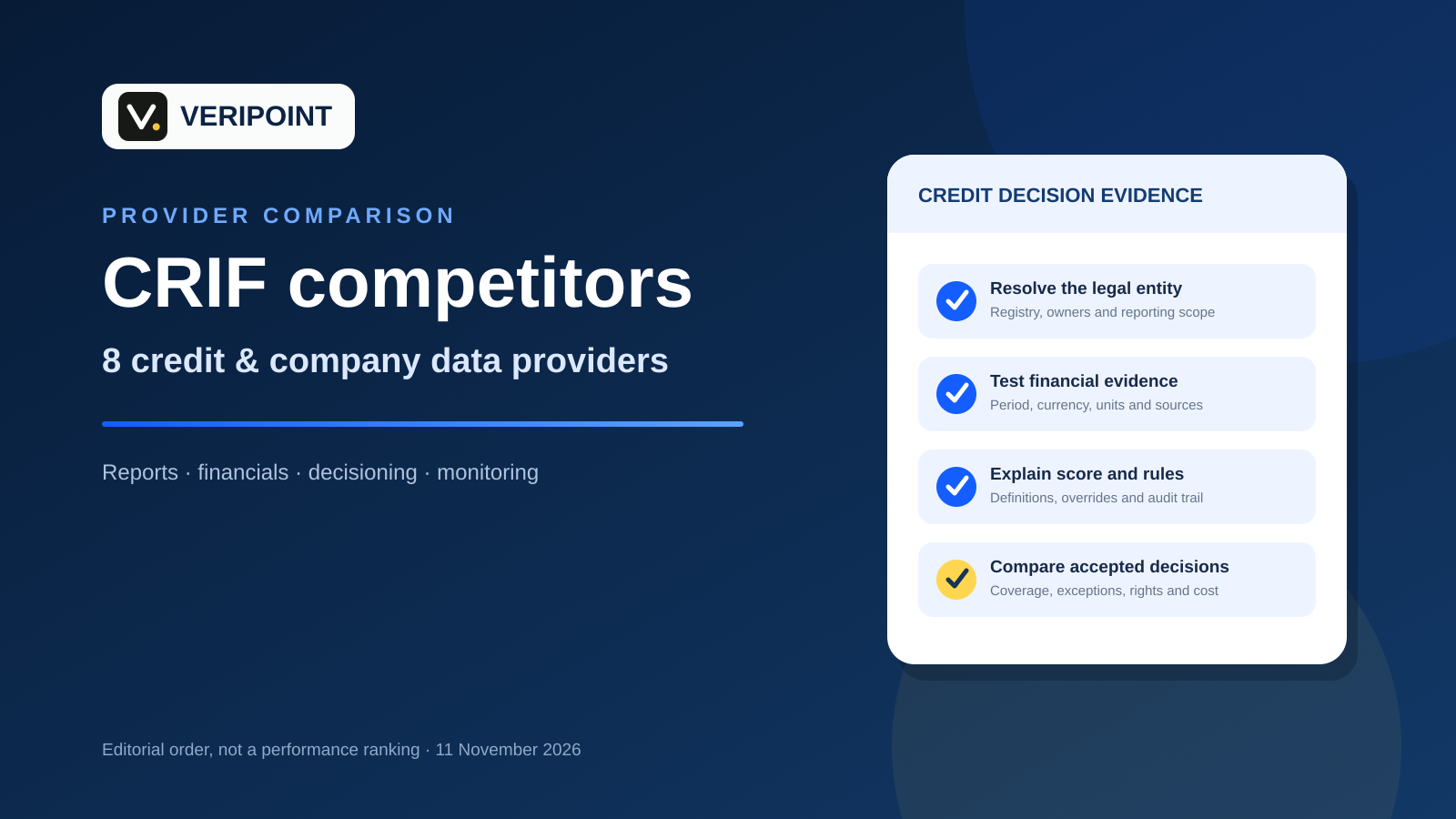
CRIF competitors should be compared against the exact country, data layer and decision being bought. CRIF spans business information, country-specific credit bureaus, analytics, fraud controls, decisioning and portfolio tools. Veripoint, Global Database and Monetaiq address narrower company-financial and registry workflows. Cerved, Ellisphere and Creditreform bring local European credit context, while Worldbox combines reports, documents and investigation. The products overlap, but they are not interchangeable.
Choose the evidence layer before the brand
Keep CRIF on the shortlist when business information must connect to bureau data, fraud controls, automated decisions or portfolio monitoring in defined countries.
Choose Veripoint for explained analysis when legal entity, period, currency, units, calculations and missing evidence must remain reviewable.
Choose Global Database or Monetaiq when registry-led identity, ownership, filed accounts or normalized financial delivery is the primary requirement.
Shortlist Cerved or Ellisphere when Italian or French commercial-credit depth, local analytics and monitoring are central.
Shortlist Creditreform for local-office commercial reports and member access across European markets.
Shortlist Worldbox for specific international reports, original documents and investigative research where online files are incomplete.
Commercial disclosure: Veripoint is by Global Database. Monetaiq’s legal footer identifies Global Data Intelligence Limited, the same company behind Global Database. They are affiliated products with different workflows, not three independent endorsements. The order follows this series’ editorial format and is not an objective ranking or independent product test.
Compare the shortlist
Choose by data, workflow and cost. The order is editorial, not a performance ranking. Select a provider to read the full review.
| Provider / focus | Strengths | Limitations | Pricing | Best for |
|---|---|---|---|---|
| CRIFBusiness information, credit-bureau data, decisioning, fraud controls and portfolio risk | Business information sits beside scoring, analytics, decision support, fraud and portfolio capabilities, which can reduce handoffs in a credit-management workflow. | CRIF is a group of country-specific bureaus, data products and decisioning tools; coverage, permissible purpose, score meaning and available fields are not uniform across markets. | Quote-based globally; no public standard amountChecked 2026-11-11 | Banks, lenders, insurers and credit teams that need business information tied to decisioning, monitoring, fraud or portfolio controls in defined countries. |
| VeripointEvidence-aware private- and public-company financial research with reviewable analysis | Research keeps entity identity, reporting basis, calculations and missing evidence together instead of reducing the decision to an unexplained score. | Veripoint is not a consumer credit bureau, loan-origination engine, fraud platform or replacement for CRIF country-specific bureau data. | Free; USD 99, USD 199 or USD 499 per monthChecked 2026-11-11 | Finance, lending, investment, procurement and corporate-development analysts who need explained company-financial research with visible evidence boundaries. |
| Global DatabaseRegistry-led legal-entity identity, ownership, filed financials and licensed delivery | Registry-led identifiers and sources help distinguish a parent, subsidiary, branch and similarly named company before financial or credit analysis begins. | Registry and filed-company data do not reproduce CRIF consumer bureau files, payment pools, fraud tools or automated decisioning products. | Regis Free or displayed $99/month; Corporate customChecked 2026-11-11 | Risk, compliance and data teams that need sourced legal-entity, ownership and filed-company evidence with contractually defined delivery rights. |
| MonetaiqNormalized company financial statements, ratios and volume-based API access | The public price page identifies monthly financial-report allowances, so the primary consumption unit is visible before an enterprise sales process. | Normalized accounts do not replace CRIF consumer or commercial bureau data, payment experience, fraud prevention or credit-decision orchestration. | Displayed $99, $199, $499 or $999 per monthChecked 2026-11-11 | Research and data teams that mainly need normalized company accounts with visible report-volume economics and API delivery. |
| CervedItalian business information, credit-risk analytics, monitoring and credit-management workflow | Credit Suite combines company information, financial and payment data, risk analysis, relationship views, monitoring and portfolio tools in one credit-management environment. | Cerved’s strongest differentiation is Italian company and credit context; buyers with a global portfolio must test each market, source and turnaround separately. | Quote-based; no public Credit Suite amountChecked 2026-11-11 | Credit managers and finance teams with significant Italian counterparties that need local business information, monitoring and portfolio-risk tools. |
| EllisphereFrench company intelligence, credit-risk management, investigations and international reports | French company information is enriched with private sources, payment and field information, human verification and analyst-led investigations. | International coverage depends on partner networks and should not be assumed to have the same depth, freshness or source chain as France and Monaco. | Quote-based; current standard amount not publicChecked 2026-11-11 | French and European credit teams that need solvency monitoring, analyst investigations and system delivery around commercial counterparties. |
| CreditreformEuropean commercial credit reports, membership access and international business information | A long-established European network provides local commercial reports and a shared international portal for cross-border credit checks. | The product and contract are country-office dependent, so report fields, scores, delivery, support and prices can vary across jurisdictions. | Local-office quote; no global standard amountChecked 2026-11-11 | European credit and collections teams that value local commercial-report expertise and member access across multiple national offices. |
| WorldboxWorldwide company reports, registry documents, credit risk and investigative research | Online records can be supplemented with freshly ordered registry documents and investigator-produced reports where standard databases are insufficient. | Report contents repeatedly qualify fields as available where possible, so completeness, freshness, sources and turnaround must be tested by country. | Per-report or bespoke quote; public universal amount not shownChecked 2026-11-11 | Credit, compliance and due-diligence teams needing country-specific company reports, official documents or investigative research in difficult jurisdictions. |
Credit intelligence and company research are different categories
Business credit reports are designed for a counterparty decision. Depending on country and product, they can include identity, financials, payment behaviour, legal events, scores, opinions, recommended limits and monitoring. CRIF, Cerved, Ellisphere, Creditreform and Worldbox operate in this layer, but no shared label guarantees the same fields or model. A score of “low risk” is meaningful only with its scale, reference population, observation date, default definition and treatment of overrides.
Private-company financial platforms begin with a resolved legal entity and the accounts it is required or chooses to file. The critical context is the reporting period, filing date, currency, units and standalone or consolidated scope. Veripoint emphasizes explained analysis; Monetaiq emphasizes normalized statements and delivery; Global Database emphasizes registry and ownership evidence. None can create a complete history where local disclosure rules do not require one.
Registry data answers whether the entity exists, who controls or manages it, how it is linked and what it has filed. Registry evidence can be decisive for onboarding, KYB and group mapping, but it is not the same as payment experience or a bureau model. Global Database is the registry-led specialist in this shortlist. Worldbox can order current registry documents, while the credit providers also incorporate official sources within broader reports.
Decisioning platforms turn inputs into rules, scores, decisions and monitored workflows. CRIF’s proposition extends into this layer. A decision platform should be evaluated not only on data breadth but on rule versioning, explanations, overrides, audit logs, permissions, model monitoring, fallback behaviour and integration latency. A company-research workspace or report provider may supply an input without becoming the system that approves credit.
Public-market terminals organize real-time prices, security identifiers, news, estimates, research, portfolio analytics and trading-adjacent workflows. They may include company fundamentals, but they are not automatically commercial credit bureaus. For that category, see the Bloomberg Terminal alternatives, FactSet competitors and LSEG Workspace comparison.
Private-capital intelligence focuses on funds, investors, rounds, transactions and private-market relationships. It can be valuable for origination or deal work, yet it does not replace statutory accounts or a trade-credit report. The PitchBook competitors guide covers that market. Procurement should write the category boundary before demonstrations begin, because broad “company intelligence” language can make unlike products appear equivalent.
Eight CRIF competitors reviewed by buyer fit
Official product and pricing pages were checked independently on 11 November 2026. The table and detailed reviews use the identical eight-provider collection and order. Quote-only products remain quote-only. Published amounts apply only to the named regional or online product, visible currency, unit and billing basis. A local CRIF plan is not presented as a global tariff, old or reseller pricing is not treated as current vendor pricing, and unavailable prices are not plotted as zero.
Business information, credit-bureau data, decisioning, fraud controls and portfolio risk
CRIF
CRIF is the featured provider because its proposition extends beyond a business credit report. Its business-information services combine company and payment information, reports, analytics and portfolio tools, while other CRIF products support consumer and commercial credit bureaus, fraud prevention, open banking and automated decisioning. The official global page says CRIF has a presence in 37 countries and connects its local information capabilities with the SkyMinder international business-information platform. Buyers therefore need to identify the country, product and data layer they actually require before comparing a proposal.
Strengths
- Business information sits beside scoring, analytics, decision support, fraud and portfolio capabilities, which can reduce handoffs in a credit-management workflow.
- CRIF combines an international footprint with local sources and country-specific bureau operations rather than presenting one undifferentiated global file.
- The September and October 2026 launches of CRIF ORCHESTRA and CRESCENDO show continued investment in configurable decision intelligence and governed credit workflows.
Limitations
- CRIF is a group of country-specific bureaus, data products and decisioning tools; coverage, permissible purpose, score meaning and available fields are not uniform across markets.
- A credit score, recommendation or automated rule is not a substitute for reviewing the underlying legal entity, financial period, source evidence and the buyer’s own credit policy.
- The reviewed global product pages do not publish a standard currency amount, named-user or report unit, billing period or enterprise contract term.
- Pricing
- Quote-based globally; no public standard amount CRIF’s global business-information and decisioning pages direct buyers to local or sales channels. No standard currency, per-user or per-report amount, billing period or term was published for the compared global service. ICAP CRIF’s regional MyRA page displayed a EUR 700 per year subscription example, excluding VAT, when checked, but that local product is not a global CRIF tariff and is not used as a cross-vendor price benchmark. Require country, bureau, reports, users, portfolio size, monitoring, integrations, implementation, support, renewal and termination in a matched quote.Pricing checked 2026-11-11.
- Best for
- Banks, lenders, insurers and credit teams that need business information tied to decisioning, monitoring, fraud or portfolio controls in defined countries.
Evidence-aware private- and public-company financial research with reviewable analysis
Veripoint
Veripoint is a focused company-research workspace for resolving a legal entity, retrieving available financial and ownership records, comparing periods and producing explained analysis. It is relevant when a CRIF buyer mainly needs a reviewable company-financial answer rather than a bureau score or an automated origination platform. The workflow keeps reporting period, filing date, currency, units, accounting scope, calculations and evidence limitations beside the conclusion. Public plans let teams test representative companies before expanding usage.
Strengths
- Research keeps entity identity, reporting basis, calculations and missing evidence together instead of reducing the decision to an unexplained score.
- Available private- and public-company records can be investigated in one workflow, with mismatched periods or scopes preserved as limitations.
- Published monthly plans and a Free tier allow a controlled pilot before negotiating higher-volume provider APIs, original filings or custom data feeds.
Limitations
- Veripoint is not a consumer credit bureau, loan-origination engine, fraud platform or replacement for CRIF country-specific bureau data.
- Available statements, ownership and history depend on the exact entity, jurisdiction, filing regime and underlying source publication.
- Workspace subscriptions do not automatically include direct-provider APIs, bulk raw data, redistribution rights or every original filing.
- Pricing
- Free; USD 99, USD 199 or USD 499 per month Prices are USD before tax, billed monthly: Pro includes 100 completed searches, Business 300 and Enterprise 1,000. Annual charges are USD 1,009.80, USD 2,029.80 and USD 5,089.80. Free includes three completed searches per day. Business and Enterprise add daily monitoring for up to 25 and 100 companies. Direct data APIs, bulk files and custom feeds are separately scoped.Pricing checked 2026-11-11.
- Best for
- Finance, lending, investment, procurement and corporate-development analysts who need explained company-financial research with visible evidence boundaries.
Registry-led legal-entity identity, ownership, filed financials and licensed delivery
Global Database
Global Database connects company identity, registry evidence, directors, shareholders, corporate groups, filed financials and enterprise delivery through Regis, its wider platform, APIs and bulk services. It is relevant when a CRIF comparison is really about confirming the counterparty, mapping ownership or obtaining a contractually defined company dataset. The public Regis proposition emphasizes sourced registry answers and visible timestamps. This is a different evidence layer from a bureau score or automated lending decision.
Strengths
- Registry-led identifiers and sources help distinguish a parent, subsidiary, branch and similarly named company before financial or credit analysis begins.
- Regis provides natural-language company research with sourced identity, financial, officer, shareholder and group information where available.
- Corporate delivery can combine KYB, ownership, directors, financials, linkage, APIs, bulk files and commercial licensing for defined enterprise use cases.
Limitations
- Registry and filed-company data do not reproduce CRIF consumer bureau files, payment pools, fraud tools or automated decisioning products.
- Filed accounts, ownership disclosure, original documents and update timing vary by jurisdiction, entity and registry rules.
- The published Regis price is not a quote for Corporate API, bulk delivery, redistribution, unlimited users or every Global Database dataset.
- Pricing
- Regis Free or displayed $99/month; Corporate custom The official Regis page displays Free with five credits per month and Pro at $99 per month, billed monthly, with 200 credits. The page shows a dollar sign without an explicit currency code, so settlement currency and tax must be confirmed. Free and Pro are view-only for CSV/PDF and exclude API access. Corporate downloads, API, bulk delivery, unlimited seats and lookups, redistribution and commercial licensing are quote-based.Pricing checked 2026-11-11.
- Best for
- Risk, compliance and data teams that need sourced legal-entity, ownership and filed-company evidence with contractually defined delivery rights.
Normalized company financial statements, ratios and volume-based API access
Monetaiq
Monetaiq concentrates on structured company accounts: balance sheet, income statement, cash flow, ratios and filing history for private and public companies. It is relevant when the requirement is repeatable financial retrieval for models, screening or an internal workflow rather than CRIF bureau and decisioning services. Searches and identifier lookups are free, while an allowance is consumed when a full financial record is retrieved. That unit makes it possible to model cost against a frozen company sample.
Strengths
- The public price page identifies monthly financial-report allowances, so the primary consumption unit is visible before an enterprise sales process.
- Statements and ratios are normalized into a repeatable schema and retain source and filing-date context for available company records.
- Business and Scale add monitoring; bulk statements, original filings, redistribution and higher-volume delivery can be separately scoped.
Limitations
- Normalized accounts do not replace CRIF consumer or commercial bureau data, payment experience, fraud prevention or credit-decision orchestration.
- Coverage and history vary by entity and filing regime; one successful company record does not promise every field or year for the next entity.
- The plan cards and detailed table publish different daily API limits, so throughput must be confirmed in writing before purchase.
- Pricing
- Displayed $99, $199, $499 or $999 per month The official page displays Starter, Growth, Business and Scale at $99, $199, $499 and $999 per month with 200, 600, 3,000 and 10,000 financial reports. It advertises 15% off annual billing. The page uses dollar signs without an explicit currency code, so settlement currency and tax must be confirmed. Monthly allowances reset; bulk files, original filings, redistribution and higher limits are separate. Confirm the daily limit because plan cards and the comparison table conflict.Pricing checked 2026-11-11.
- Best for
- Research and data teams that mainly need normalized company accounts with visible report-volume economics and API delivery.
Italian business information, credit-risk analytics, monitoring and credit-management workflow
Cerved
Cerved Credit Suite is a business-information and credit-management platform centered on the reliability, relationships and economic-financial position of customers, prospects and suppliers in Italy and abroad. The reviewed product describes credit and fraud risk, sustainability, relationship analysis, payment behaviour, portfolio segmentation and support for collections. Cerved Group’s business-information products must be distinguished from the separately governed Cerved Rating Agency and its formal credit-rating activities.
Strengths
- Credit Suite combines company information, financial and payment data, risk analysis, relationship views, monitoring and portfolio tools in one credit-management environment.
- Its Italian information and analytics are relevant when the buying population is concentrated in Italy and local company context matters.
- Users can enrich Cerved information with their own accounting and exposure data for portfolio analysis and tailored credit indicators.
Limitations
- Cerved’s strongest differentiation is Italian company and credit context; buyers with a global portfolio must test each market, source and turnaround separately.
- The product is not a general public-market terminal, and Cerved Rating Agency products should not be assumed included in a Credit Suite contract.
- The reviewed Credit Suite page does not publish a standard currency, user or report amount, billing period or contract term.
- Pricing
- Quote-based; no public Credit Suite amount The official Credit Suite page invites contact and does not publish a standard currency, per-user or per-report amount, billing period or term. A separate Cerved catalogue page explicitly showed no price list for its named integrated commercial-information product when checked. Require users, Italian and international coverage, reports, payment data, monitoring, portfolio volume, integrations, collections support, implementation, tax, renewal and exit terms in writing.Pricing checked 2026-11-11.
- Best for
- Credit managers and finance teams with significant Italian counterparties that need local business information, monitoring and portfolio-risk tools.
French company intelligence, credit-risk management, investigations and international reports
Ellisphere
Ellisphere’s ELLIPRO Risk Management platform combines official and private sources, company information, solvency analysis, default and fraud indicators, credit opinions, monitoring and delivery through SaaS, API or system connectors. France and Monaco are produced directly by Ellisphere, while European and international information relies on partner networks. Premium investigations add analyst commentary for material or complex exposures. This makes Ellisphere relevant for French credit teams, but not identical to CRIF’s broader bureau and decisioning portfolio.
Strengths
- French company information is enriched with private sources, payment and field information, human verification and analyst-led investigations.
- The product provides Business Profile and Smart Profile report levels alongside monitoring, default-risk, fraud and recommended credit-limit indicators.
- Documented access modes include web SaaS, API and business-system connectors, supporting both analyst and integrated workflows.
Limitations
- International coverage depends on partner networks and should not be assumed to have the same depth, freshness or source chain as France and Monaco.
- Marketing references to predictive or AI-supported indicators do not replace validation of definitions, populations, overrides and performance for the buyer’s portfolio.
- Current ELLIPRO pages reviewed do not publish a standard price, currency, user/report unit, billing period or contract term.
- Pricing
- Quote-based; current standard amount not public Current ELLIPRO Risk Management and investigation pages route buyers to a demonstration or contact process. They do not publish a current standard currency amount, user or report unit, billing period or term. Older or reseller prices are not treated as current Ellisphere tariffs. Request countries, report types, investigations, users, monitoring population, API or connector scope, support, implementation, taxes, renewal and termination in a dated quote.Pricing checked 2026-11-11.
- Best for
- French and European credit teams that need solvency monitoring, analyst investigations and system delivery around commercial counterparties.
European commercial credit reports, membership access and international business information
Creditreform
Creditreform provides commercial reports and business information through country offices and an international network. Its online service is positioned for immediate European credit decisions and says members can access more than 88 million reports across 34 European countries and China. The organization’s local-office and membership model can be useful where European commercial intelligence and service support matter, but the exact report, price and contractual entity depend on the country office.
Strengths
- A long-established European network provides local commercial reports and a shared international portal for cross-border credit checks.
- Reports can combine identity, management, financial, payment, adverse-event and credit-opinion information according to the country product.
- Local offices can support country-specific interpretation and enquiries rather than offering only a self-service global database.
Limitations
- The product and contract are country-office dependent, so report fields, scores, delivery, support and prices can vary across jurisdictions.
- Membership access and a broad report count do not prove that every required company has current accounts, payment data or the same source documents.
- The reviewed international pages direct buyers to a local office and do not publish a single currency, report or user amount, billing period or term.
- Pricing
- Local-office quote; no global standard amount Creditreform’s international business-information page says price enquiries should be made with the nearest country office. No global standard currency, per-report or per-user amount, billing basis or term was published. Ask the contracting office to specify membership fees, report units, monitoring, international access, API or export rights, minimum spend, support, taxes, renewal and termination.Pricing checked 2026-11-11.
- Best for
- European credit and collections teams that value local commercial-report expertise and member access across multiple national offices.
Worldwide company reports, registry documents, credit risk and investigative research
Worldbox
Worldbox Business Intelligence combines online company and credit reports with newly obtained registry documents and offline investigation. Its official pages describe identity, operations, ownership, management, financial information where available, payment experience, credit opinions and bespoke research when a record is not ready online. This model is useful for difficult jurisdictions and specific counterparties. It is a report and investigation service rather than a replacement for CRIF’s country bureaus or enterprise decisioning stack.
Strengths
- Online records can be supplemented with freshly ordered registry documents and investigator-produced reports where standard databases are insufficient.
- The report proposition covers company identity, ownership, management, financial information where available, payment experience and credit opinion.
- A documented API and tailored packages support ordering company reports, financial data, credit reports and legal documents.
Limitations
- Report contents repeatedly qualify fields as available where possible, so completeness, freshness, sources and turnaround must be tested by country.
- Worldbox is not a consumer credit bureau, automated lending platform, public-market terminal or broad portfolio-decision engine.
- The public pages refer to current price lists, online units and bespoke offers but do not expose one universal currency, amount or billing basis before account context.
- Pricing
- Per-report or bespoke quote; public universal amount not shown Worldbox says services use a current price list and may receive volume offers, while product pages invite registration, a demo or a tailored package. No universal currency, per-report amount, subscription fee or billing period was public on the pages reviewed. Confirm report type, country, turnaround, currency, tax, prepaid-credit expiry, monitoring, API, users, volume and reuse rights.Pricing checked 2026-11-11.
- Best for
- Credit, compliance and due-diligence teams needing country-specific company reports, official documents or investigative research in difficult jurisdictions.
Credit platforms are becoming decision systems
CRIF’s 2026 product announcements make this comparison broader than choosing a report. On 30 September, CRIF announced ORCHESTRA as a decision-intelligence environment intended to connect data, analytics, rules, automation and governance. On 5 October it introduced CRESCENDO within ORCHESTRA, and on 2 November announced an AI-supported credit-decisioning implementation with Raiffeisen Bank Romania. These are provider announcements, not independent performance tests. They show that buyers are increasingly procuring a controlled decision workflow rather than a static file.
That shift changes the risk. An entity-match error, stale filing or unexplained score can move from one analyst’s screen into thousands of automated decisions. Evaluation therefore needs lineage from source to field, field to feature, feature to score, and score to rule. Teams should be able to reproduce the decision that was made, see which version was active, identify manual overrides and preserve the evidence needed for review.
The market context also argues for better controls. CRIF’s July 2026 European Credit Outlook described a resilient but weakening environment for a sample of large EU companies and forecast higher default rates under both baseline and adverse scenarios. Cerved’s October outlook likewise anticipated increasing Italian business deterioration rates. Those forecasts are not interchangeable and should not be applied mechanically to an individual counterparty. They illustrate why portfolio monitoring, sector context and explicit scenario assumptions matter alongside a point-in-time score.
Specialists are developing in parallel. Ellisphere documents a SaaS, API and connector model around French and international risk information. Worldbox combines online reports with freshly ordered documents and investigation. Cerved combines risk, fraud, sustainability, relationship and payment analysis within Credit Suite. The practical question is not which marketing page lists the most capabilities. It is which provider can produce the required evidence, at the required time, under the required rights for the buyer’s actual population.
Map each provider to the workflow it is built to support
The matrix summarizes documented product emphasis. “Core” means central to the reviewed proposition, “available” means described but dependent on product, country, entity or contract, and “adjacent” means it is not the primary job. It is a category map, not a vendor score, field-level coverage test or claim that similarly labelled cells contain equivalent information.
Eight providers cover different decision layers
| Provider | Business credit | Private financials | Registry & ownership | Decisioning & fraud | Investigative reports |
|---|---|---|---|---|---|
| CRIF | Core | Available | Available | Core | Available |
| Veripoint | Adjacent | Core | Available | Adjacent | Adjacent |
| Global Database | Available | Core | Core | Adjacent | Adjacent |
| Monetaiq | Adjacent | Core | Available | Adjacent | Adjacent |
| Cerved | Core | Core | Available | Core | Available |
| Ellisphere | Core | Available | Available | Available | Core |
| Creditreform | Core | Available | Available | Adjacent | Available |
| Worldbox | Core | Available | Core | Adjacent | Core |
Use a disclosed evaluation model, not invented vendor scores
The illustrative weights below total 100% and are deliberately not assigned to any provider. A regulated lender may increase governance and permissible-purpose weight. A trade-credit team may increase payment experience and monitoring. A research team may emphasize financial history and source documents. Set the weights before demonstrations, define a pass/fail gate for mandatory controls, and keep the raw evidence beside any calculated score.
A defensible shortlist starts with the decision
Use hard gates as well as weights. A provider that cannot establish the legal entity, lawful purpose, score definition, source date or required audit trail should not compensate with a low price. Likewise, an attractive API is not useful if the contract prohibits the storage, model use or customer display needed by the application. Ask the legal, risk, security and operational owners to sign off on acceptance criteria before commercial selection.
Compare accepted decisions, not just subscription fees
Most providers in this shortlist require a proposal, so a factual public price chart would create false precision. The model below is explicitly illustrative. It shows how implementation and manual exception work can reverse a simple licence comparison. Both scenarios assume one year, fictional USD inputs, a fully loaded analyst cost of USD 45 per manual review, and no vendor assignment. Taxes, bureau transaction charges, local-office fees, integration maintenance, monitoring, remediation and exit costs are excluded.
Normalize cost per accepted credit decision
Scenario A · lower licence, more exceptions
USD 18,000 platform + USD 8,000 implementation + 480 manual reviews × USD 45 = USD 47,600.
USD 39.67 per 1,200 accepted decisionsScenario B · higher licence, fewer exceptions
USD 30,000 platform + USD 12,000 implementation + 220 manual reviews × USD 45 = USD 51,900.
USD 35.79 per 1,450 accepted decisionsExtend the model over the proposed term. Include data or bureau transactions, minimum commitments, named users, monitoring populations, decisions, implementation, connectors, security review, parallel running, analyst exceptions, false-match remediation, support, annual uplift, renewal notice, data extraction and decommissioning. Apply the same volume and exchange-rate assumptions to every proposal. Where a price depends on country or report type, preserve that unit instead of compressing unlike services into one headline figure.
Run a frozen, evidence-led pilot
Build the sample before vendors see it. Include high- and low-risk companies, recent and stale filings, group structures, thin files, sole traders where relevant, cross-border entities, name collisions, changed directors, insolvency events, unavailable accounts and a set that the current process rejects. Record the registration number, country, decision date and expected source for every case. A vendor should not be rewarded for returning a confident answer to the wrong legal entity.
For each case, capture match accuracy, report and source date, financial period and scope, missing fields, payment evidence, score and limit explanation, adverse events, monitoring trigger, processing time and manual intervention. For automated workflows, test rule changes, overrides, replay, access permissions, logs, timeouts, duplicate requests and fallback handling. For APIs, test identifiers, rate limits, retries, versioning, export formats and termination access using the same acceptance scripts.
Commercial evaluation should use a matched three-year schedule. Separate platform, user, report, portfolio, decision, API, implementation, investigation, support and local-office charges. Confirm tax and currency. Obtain explicit rights for storage, derived metrics, model training or use, internal display, customer display and redistribution. Screen access, a PDF download and an API response do not grant the same rights.
Finally, plan the exit before signing. Define parallel-run thresholds, data retention, deletion evidence, unresolved disputes, monitoring handoff, decision reproducibility and rollback. Keep the existing provider until the replacement meets the mandatory gates on the frozen sample. A successful demo is not production acceptance, and a submitted indexing request is not evidence that this article—or any provider’s content—will be indexed or ranked.
Run representative companies through Veripoint before committing to a broader credit-data stack.
Inspect entity context, periods, currencies, calculations and missing evidence, then compare the result with your bureau and decisioning requirements.
Analyse a company See pricingQuestions buyers ask before a shortlist
What are the best CRIF competitors?
The best CRIF competitor depends on the product and country being replaced. Veripoint fits explained company-financial research; Global Database fits registry identity, ownership and filed evidence; Monetaiq fits normalized financial delivery; Cerved and Ellisphere fit Italian and French credit-management contexts; Creditreform fits European commercial reports; and Worldbox fits country-specific reports and investigation. CRIF remains a strong candidate when business information must connect directly to bureau data, fraud controls, decisioning or portfolio management.
What is the best CRIF alternative for business credit reports?
There is no universal substitute because report content and legal access vary by country. Cerved is relevant for Italian counterparties, Ellisphere for French solvency and investigations, Creditreform for European commercial reports, and Worldbox for international reports and registry documents. Global Database can strengthen entity and ownership evidence. Compare the same legal entities and require the report date, original sources, financial period, payment data, score definition, recommended limit, monitoring rules and turnaround.
How much does CRIF cost?
CRIF does not publish one global business-information price, currency, per-user or per-report unit, billing period or enterprise term on the official pages reviewed on 11 November 2026. Buyers are directed to local or sales channels. An ICAP CRIF regional MyRA page displayed a EUR 700 per year subscription example excluding VAT, but that named regional plan is not a global tariff. A matched quote should specify countries, bureau files, reports, users, portfolios, decisions, integrations, support, renewal and termination.
What is a CRIF credit report?
A CRIF credit report is a country- and product-specific credit-information output used to assess a person or business. For companies, it may include identity, financial, payment, adverse-event, ownership, scoring or recommended-limit information, depending on jurisdiction and service. Consumer bureau reports are governed differently and should not be confused with commercial company reports. Buyers must confirm the legal entity, permissible purpose, data sources, score scale, observation date, update cycle and dispute or correction process.
How is CRIF different from a company financial database?
CRIF can combine company information with bureau data, payment behaviour, fraud controls, analytics, decisions and portfolio monitoring. A company financial database such as Monetaiq focuses on normalized statements, while Global Database focuses on registry identity, ownership and filed evidence. Veripoint focuses on explained analysis. These layers overlap, but a normalized balance sheet does not become a bureau file, and a credit score does not replace the accounts, period, currency, scope and evidence behind a decision.
Which CRIF alternative is best for private-company financials?
Veripoint is a focused choice when an analyst needs a reviewable conclusion with entity, reporting period, filing date, currency, units, accounting scope, calculations and evidence gaps kept together. Monetaiq is relevant for normalized statements and report-volume API delivery, while Global Database adds registry and ownership context. Cerved, Ellisphere, Creditreform and Worldbox add credit-oriented information in their respective markets. Test the exact registration numbers and periods because no provider guarantees complete accounts for every private company.
Does CRIF provide automated credit decisioning?
Yes. CRIF markets decisioning, analytics and orchestration products in addition to business information. In September 2026 it launched CRIF ORCHESTRA, and in October it announced CRESCENDO within that environment. Those are provider announcements, not proof of performance for a buyer. Procurement should test rule governance, score definitions, overrides, adverse-action or explanation needs, model monitoring, permissions, audit logs, integrations, latency, fallback behaviour and human approval before any automated decision goes live.
What is the difference between CRIF and a public-market terminal?
CRIF is centered on credit information, business information, risk, fraud and decision workflows. Public-market terminals organize real-time prices, news, estimates, research, portfolio analytics and trading-related data for securities. They may contain company fundamentals, but they are not automatically commercial credit bureaus or sources of payment experience. If listed-company markets are the primary need, review the Bloomberg, FactSet or LSEG comparisons; if private-company accounts are central, test filing and entity depth directly.
Can CRIF alternatives support API and bulk-data workflows?
Several can, but screen access never implies bulk or redistribution rights. Global Database offers Corporate API and bulk delivery, Monetaiq offers report-volume API access and separately scoped bulk files, Ellisphere documents API and system connectors, and Worldbox documents programmatic report ordering. Veripoint includes a workspace API within plan allowances while direct provider data is separate. Require fields, identifiers, history, rate limits, refresh, retries, storage, derived-data, model-use, customer-display, audit, security and termination rights in writing.
How should a company evaluate CRIF competitors?
Define the decision, countries and regulated data first. Freeze a representative sample of approved, declined, thin-file, cross-border and deliberately difficult entities. Give every provider the same tasks and record identity accuracy, report date, source traceability, missing values, score meaning, overrides, latency and manual work. Compare matched three-year proposals including implementation, monitoring, local-office fees and exceptions. Keep the incumbent until acceptance thresholds, parallel running, data retention, migration and rollback are proven.
Method: Veripoint reviewed public official product, pricing and 2026 announcement pages on 11 November 2026. Descriptions and coverage figures are provider statements, not independent tests. Public prices are shown only for the named product and unit. Enterprise or unavailable pricing remains quote-based. Research URLs and keyword evidence are retained privately; no ranking, coverage, savings or inclusion outcome is promised.