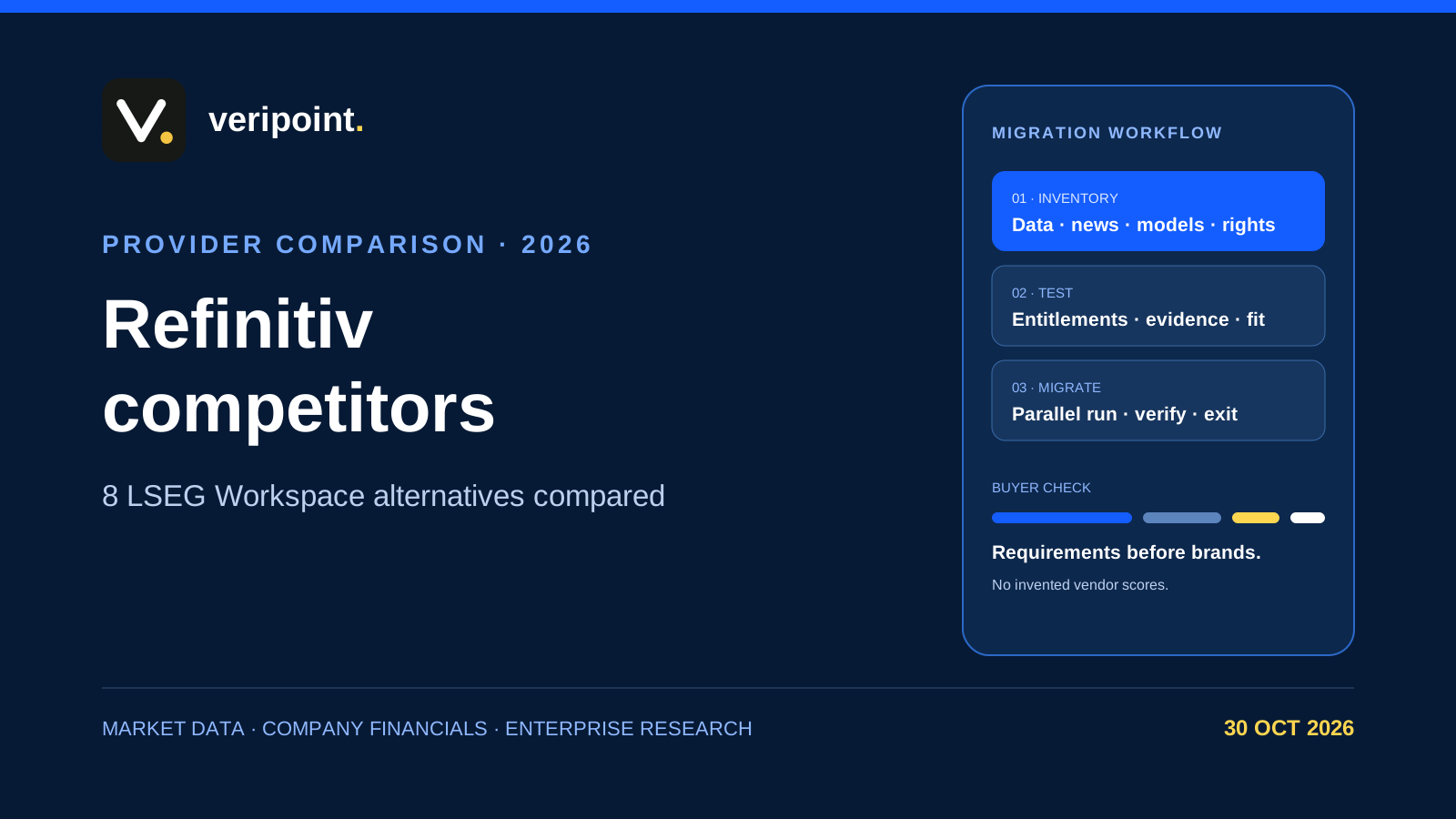
Refinitiv competitors now need to be compared with LSEG Workspace, not with a standalone Refinitiv product. LSEG retired the Refinitiv brand and withdrew Eikon from its product line on 30 June 2025. The right alternative depends on what the team actually uses: real-time market data, Reuters news, models, messaging, private-company accounts, registry evidence, credit intelligence or licensed data delivery.
Choose by workflow, entitlement and evidence
Keep LSEG Workspace on the shortlist when Reuters news, cross-asset data, analytics, Microsoft interoperability and role-specific institutional workflows are central.
Compare Bloomberg Terminal when professional messaging, Bloomberg news and data, multi-asset analytics or execution-connected work are embedded in the role.
Compare FactSet or S&P Capital IQ Pro when company research, estimates, transactions, modelling and investment workflows matter more than broad terminal continuity.
Choose Veripoint for focused analysis when users need reviewable company-financial research with periods, units, calculations and evidence gaps made explicit.
Choose Global Database or Monetaiq for structured data when legal-entity, ownership, filed-financial or normalized-statement delivery is the real requirement.
Use Yahoo Finance only for lightweight public-market research where consumer access, quotes, charts and portfolios are sufficient and enterprise entitlements are not required.
Commercial disclosure: Veripoint is by Global Database. Monetaiq’s legal footer identifies Global Data Intelligence Limited, the same company behind Global Database. They are affiliated products with different workflows, not three independent endorsements. The provider order follows this series’ editorial format and is not an objective ranking or the result of independent product testing.
Compare the shortlist
Choose by data, workflow and cost. The order is editorial, not a performance ranking. Select a provider to read the full review.
| Provider / focus | Strengths | Limitations | Pricing | Best for |
|---|---|---|---|---|
| LSEG Workspace (formerly Refinitiv)Cross-asset market data, Reuters news, analytics, research and Microsoft-connected workflows | LSEG states that Workspace joins trusted data, market-moving news, analytics and AI-powered intelligence across investment, banking, trading, wealth and corporate workflows. | Broad product availability does not mean every exchange, dataset, private-market module, Reuters or third-party content set, add-in, feed or API is included in one proposal. | Quote-based; no public standard currency amountChecked 2026-10-30 | Institutional teams that need cross-asset market data, Reuters news, research, analytics and collaboration in a governed professional workflow. |
| VeripointEvidence-aware company-financial research, comparisons and analyst-ready reports | Guided research keeps company identity, periods, currency, units, accounting scope, calculations and evidence limitations beside the financial conclusion. | Veripoint does not claim to replace real-time exchange feeds, Reuters news, professional messaging, execution tools or the full cross-asset application catalogue of LSEG Workspace. | Free; USD 99, USD 199 or USD 499 per monthChecked 2026-10-30 | Finance, lending, investment, procurement and corporate-development analysts who need explainable company-financial research rather than a real-time markets terminal. |
| Global DatabaseRegistry-led identity, ownership, filed financials and licensed enterprise delivery | Regis combines company questions with visual profiles, source context, financials, directors, shareholders and group structure in a self-serve evaluation route. | A company and registry data platform does not replace LSEG real-time market feeds, Reuters news, execution analytics or professional communications. | Regis Free or displayed $99/month; Corporate customChecked 2026-10-30 | Enterprise teams that need legal-entity certainty, ownership, filed company evidence and contractually scoped API or bulk delivery. |
| MonetaiqNormalized private- and public-company statements with volume-based API access | The official pricing page publishes four monthly financial-report allowances instead of hiding entry pricing behind an enterprise sales process. | Normalized accounts do not replace real-time prices, Reuters news, analyst research, professional messaging, execution workflows or the terminal application layer. | Displayed $99, $199, $499 or $999 per monthChecked 2026-10-30 | Research and data teams that mainly need normalized company accounts with visible report-volume economics and API access. |
| Bloomberg TerminalReal-time multi-asset markets, news, analytics, communications and execution-connected workflows | The Terminal joins market data, news, research, analytics, collaboration and execution-adjacent tools across asset classes in one professional environment. | Bloomberg is not an official registry, dedicated commercial credit bureau or specialist source of statutory private-company accounts; those jobs may still require another provider. | Quote-based subscription; no public standard amountChecked 2026-10-30 | Trading, investment, treasury and markets teams that depend on real-time data, news, analytics, professional communications and execution-connected workflows. |
| S&P Capital IQ ProCompany fundamentals, estimates, transactions, documents, screening and Excel modelling | S&P Global currently describes 109,000+ public companies and a database of 60M+ private companies, alongside estimates, transactions, fixed-income and ownership data. | S&P Global’s product family is broad, so Capital IQ Pro access should not be assumed to include ratings, every private-market dataset, feeds or redistribution rights. | Quote-based; no public standard amountChecked 2026-10-30 | Investment banking, equity research and corporate-finance teams needing company fundamentals, estimates, transactions, documents and Excel-linked modelling. |
| FactSetInstitutional financial data, analytics, models, portfolios and enterprise delivery | FactSet joins research, screening, modelling, portfolio analysis and data delivery rather than offering only a company lookup. | The catalogue contains many data sources and applications, so buyers must map each entitlement and avoid assuming every described capability is bundled. | Tailored quote; typically annual subscriptionChecked 2026-10-30 | Institutional investment, banking, wealth and corporate teams needing connected research, models, portfolio analytics and governed data delivery. |
| Yahoo FinanceAccessible public-market quotes, news, charts, portfolios and investor research | Free browser and app access lowers the barrier for public-market monitoring and basic listed-company research. | Yahoo Finance does not offer the same institutional catalogue, real-time exchange entitlements, professional messaging, modelling integration, support or governed delivery as LSEG Workspace. | Free; displayed $95.40, $239.40 or $479.40 per yearChecked 2026-10-30 | Individual investors and small teams needing accessible public-market quotes, news, charts, portfolios and research without an institutional workstation. |
A terminal, a financial database and a credit report are not the same product
Institutional public-market workstations combine live and historical security data, news, research, analytics, models, alerts, portfolio tools, market entitlements and collaboration. LSEG Workspace and Bloomberg Terminal sit at the broad end of that category. FactSet and S&P Capital IQ Pro overlap strongly, with particular depth in company research, models, estimates, transactions and portfolio or banking workflows. Their exact catalogues and communications ecosystems differ, so “terminal replacement” is too vague for procurement.
Private-company financial data describes what an entity’s available accounts report. Revenue, assets, debt and cash are usable only when the legal entity, reporting period, filing date, currency, units and consolidated or standalone scope are known. Veripoint, Global Database and Monetaiq serve parts of this workflow. They can be more proportionate than a markets workstation when the task is company analysis, but they do not provide every exchange, real-time feed, research entitlement or trading function.
Registry and ownership data establish who the company is: legal name, company number, jurisdiction, status, officers, filing references, disclosed owners and group links. Global Database can connect that layer with financial records and enterprise delivery. A valid registry match is foundational, but it is not proof of creditworthiness, and an attractive market-data profile attached to the wrong subsidiary is still a failed result.
Commercial credit reports add provider-specific risk opinions, payment behavior, recommended limits, monitoring and investigations. None of the eight vendors in this particular list is included primarily as a trade-credit bureau. If the decision is supplier terms or receivables risk, the Creditsafe competitors or Dun & Bradstreet competitors comparisons are better starting points. A market terminal’s bond analytics are not a substitute for a local commercial credit report.
Private-capital intelligence focuses on funds, investors, funding rounds, deals, ownership, valuations and non-public-company context. FactSet and Capital IQ Pro include relevant data, but a specialist private-capital workflow can require different sourcing and coverage. Buyers should review the PitchBook competitors comparison if deal sourcing and fund intelligence dominate. Never infer that every private company with a profile has filed financial statements or a current valuation.
These category boundaries often lead to a layered architecture. A treasury desk may retain a terminal for live markets, use a company-data service for counterparties and use a focused analysis workspace for exceptions. A corporate-development team might need Capital IQ Pro or FactSet for transactions and models, then a registry and financial source for a private target. Consolidation is valuable only when the chosen product meets each mandatory job and use right.
Eight Refinitiv alternatives, reviewed by fit and limitation
Official product, pricing and update pages were checked independently on 30 October 2026. The comparison table and full reviews use the same eight-provider collection in the same editorial order. Quote-only products remain quote-only. Published amounts apply only to the stated unit and billing basis. A Workspace licence, Terminal subscription, completed Veripoint search, Monetaiq financial report and Yahoo consumer plan are not interchangeable price units.
Cross-asset market data, Reuters news, analytics, research and Microsoft-connected workflows
LSEG Workspace (formerly Refinitiv)
LSEG Workspace is the current successor to the former Refinitiv desktop proposition and the featured institutional platform in this comparison. It combines cross-asset data, Reuters news, company and security research, analytics, role-specific applications and collaboration tools. A buyer searching for Refinitiv or Eikon alternatives should compare against the exact LSEG Workspace proposition offered today, not against a retired brand or a historic Eikon package.
Strengths
- LSEG states that Workspace joins trusted data, market-moving news, analytics and AI-powered intelligence across investment, banking, trading, wealth and corporate workflows.
- Microsoft Teams and Microsoft 365 interoperability can bring data, research and professional collaboration into tools already used by enterprise teams.
- Current development includes Workspace AI Search, Deep Research and October 2026 Equity Market Analytics for natural-language execution and market analysis.
Limitations
- Broad product availability does not mean every exchange, dataset, private-market module, Reuters or third-party content set, add-in, feed or API is included in one proposal.
- Workspace is not an official company registry or a dedicated commercial credit bureau; legal-entity provenance, statutory private-company accounts and trade-credit decisions may need another evidence layer.
- LSEG publishes no standard currency amount, named-user price, billing period or contract term for Workspace on the official pages reviewed.
- Pricing
- Quote-based; no public standard currency amount New customers are directed to an LSEG account team. The official service overview says applications are packaged into propositions by workflow and billing follows the frequency specified for the account; partner services may bill separately. Require currency, named users, term, proposition, exchange and third-party entitlements, add-ins, feeds or APIs, implementation, support, rights, renewal and termination in writing.Pricing checked 2026-10-30.
- Best for
- Institutional teams that need cross-asset market data, Reuters news, research, analytics and collaboration in a governed professional workflow.
Evidence-aware company-financial research, comparisons and analyst-ready reports
Veripoint
Veripoint is a focused workspace for researching available private- and public-company financial records, testing reporting context and producing reviewable analysis. It serves a narrower job than an institutional market terminal: resolve the legal entity, inspect available statements and periods, calculate and explain financial measures, compare companies on an aligned basis and state what evidence is missing.
Strengths
- Guided research keeps company identity, periods, currency, units, accounting scope, calculations and evidence limitations beside the financial conclusion.
- Published Free through Enterprise plans let a buyer test representative companies without first negotiating a market-data terminal contract.
- Workspace API and MCP access are included within the shared research allowance, supporting saved-report and agent workflows with scoped keys.
Limitations
- Veripoint does not claim to replace real-time exchange feeds, Reuters news, professional messaging, execution tools or the full cross-asset application catalogue of LSEG Workspace.
- Available statements and history depend on the legal entity, jurisdiction, reporting regime and underlying source publication.
- It is not an official public register, proprietary trade-payment bureau or investment-recommendation service; provider feeds and redistribution require separate terms.
- Pricing
- Free; USD 99, USD 199 or USD 499 per month USD before tax, billed monthly: Pro includes 100 completed searches, Business 300 and Enterprise 1,000. Annual charges are USD 1,009.80, USD 2,029.80 and USD 5,089.80. Registered Free workspaces include three completed searches per day. Monitoring is included on Business and Enterprise. Paid activation is currently request-led; direct provider APIs, bulk data and custom data feeds are separately scoped.Pricing checked 2026-10-30.
- Best for
- Finance, lending, investment, procurement and corporate-development analysts who need explainable company-financial research rather than a real-time markets terminal.
Registry-led identity, ownership, filed financials and licensed enterprise delivery
Global Database
Global Database provides company identity, registry evidence, officers, shareholders, group structures, filed financials, credit information and licensed delivery through its platform, Regis, APIs and bulk services. It is relevant when a Refinitiv replacement project is actually driven by legal-entity resolution, private-company evidence or data integration rather than live securities workflows.
Strengths
- Regis combines company questions with visual profiles, source context, financials, directors, shareholders and group structure in a self-serve evaluation route.
- Corporate delivery can connect KYB, ownership, directors, financials and linkage through APIs, bulk files and commercial licensing.
- The official platform proposition can scope coverage, seats, exports and report use rather than forcing a market-terminal bundle onto a company-data workflow.
Limitations
- A company and registry data platform does not replace LSEG real-time market feeds, Reuters news, execution analytics or professional communications.
- Filed-financial depth, ownership disclosure, credit fields and original documents vary by legal entity, jurisdiction and source rules.
- The published Regis price is not a quote for Corporate API, bulk, redistribution, unlimited use or every Global Database dataset.
- Pricing
- Regis Free or displayed $99/month; Corporate custom The official Regis page displays Free with five monthly credits and Pro at $99 per month billed monthly with 200 credits. The page does not label the dollar currency code, so settlement currency must be confirmed. Free and Pro are view-only for CSV/PDF and exclude API access; Corporate includes scoped downloads, API, bulk delivery and licensing. The wider platform is generally annual and quoted by coverage, users and export queries.Pricing checked 2026-10-30.
- Best for
- Enterprise teams that need legal-entity certainty, ownership, filed company evidence and contractually scoped API or bulk delivery.
Normalized private- and public-company statements with volume-based API access
Monetaiq
Monetaiq concentrates on structured financial statements, ratios and filing history for private and public companies. It is useful when the target companies are already resolved and the main requirement is repeatable financial retrieval for internal models, screening or applications. A financial-report allowance is not comparable with a Workspace user, exchange entitlement or market-data feed.
Strengths
- The official pricing page publishes four monthly financial-report allowances instead of hiding entry pricing behind an enterprise sales process.
- Balance sheet, income statement, cash flow, ratios and available filing history are normalized for repeatable analysis across markets.
- Business and Scale add monitoring, while bulk statements, original filings and higher-throughput delivery can be separately scoped.
Limitations
- Normalized accounts do not replace real-time prices, Reuters news, analyst research, professional messaging, execution workflows or the terminal application layer.
- Coverage and available history vary by company and filing regime, and a retrieved record does not guarantee every statement line or reporting year.
- The current plan cards and detailed comparison table display different daily API limits, so throughput must be confirmed before procurement.
- Pricing
- Displayed $99, $199, $499 or $999 per month The page displays dollar signs without an explicit currency code; confirm settlement currency. Starter, Growth, Business and Scale include 200, 600, 3,000 and 10,000 financial reports per month and advertise 15% off annual billing. Monthly allowances reset; bulk files, original filings, redistribution and higher limits are separately priced. Confirm the applicable daily limit because the page contains conflicting values.Pricing checked 2026-10-30.
- Best for
- Research and data teams that mainly need normalized company accounts with visible report-volume economics and API access.
Real-time multi-asset markets, news, analytics, communications and execution-connected workflows
Bloomberg Terminal
Bloomberg Terminal is the closest broad institutional alternative for many LSEG Workspace users. It combines live and historical market data, Bloomberg News, company and security research, analytics, portfolio tools, messaging and execution-connected workflows. The professional network and communications layer can be as important as the data, so substitution must be tested by role rather than brand.
Strengths
- The Terminal joins market data, news, research, analytics, collaboration and execution-adjacent tools across asset classes in one professional environment.
- Bloomberg describes a professional network of more than 350,000 decision makers, which can matter where communications are embedded in daily market workflows.
- Current product development includes ASKB, a conversational interface designed to complement existing Terminal research workflows.
Limitations
- Bloomberg is not an official registry, dedicated commercial credit bureau or specialist source of statutory private-company accounts; those jobs may still require another provider.
- The data, function, messaging and execution ecosystem can be excessive for teams that need only periodic company accounts or a narrow fundamentals feed.
- Bloomberg publishes no standard Terminal currency amount, unit, billing period or contract term on the official product pages reviewed.
- Pricing
- Quote-based subscription; no public standard amount Bloomberg directs prospective customers to order a Terminal subscription, request a demo or contact sales. Require the proposal to state currency, terminal or enterprise unit, users, term, exchange and third-party charges, add-ons, remote access, implementation, support, renewal and cancellation. Bloomberg.com consumer subscriptions are a different product and are not evidence of Terminal pricing.Pricing checked 2026-10-30.
- Best for
- Trading, investment, treasury and markets teams that depend on real-time data, news, analytics, professional communications and execution-connected workflows.
Company fundamentals, estimates, transactions, documents, screening and Excel modelling
S&P Capital IQ Pro
S&P Capital IQ Pro is a strong company-research and modelling alternative for investment banking, equity research and corporate finance. It connects public- and private-company fundamentals, consensus estimates, ownership, transactions, documents, screening and Excel-oriented workflows. Ratings and other S&P Global products remain separately scoped and should not be assumed to be included.
Strengths
- S&P Global currently describes 109,000+ public companies and a database of 60M+ private companies, alongside estimates, transactions, fixed-income and ownership data.
- ChatIQ, Document Intelligence, Chart Explainer and modelling tools can support research, comps and deal workflows.
- A 24x7x365 support proposition and enterprise data-delivery options suit teams that need more than a consumer research site.
Limitations
- S&P Global’s product family is broad, so Capital IQ Pro access should not be assumed to include ratings, every private-market dataset, feeds or redistribution rights.
- Provider-level coverage counts do not establish required-year financial depth, source-document availability or freshness for the buyer’s exact company sample.
- The official page offers request-access and personalized-demo routes but publishes no standard currency amount, named-user unit, billing period or term.
- Pricing
- Quote-based; no public standard amount S&P Global routes buyers to request access, a demo or sales follow-up. Ask for currency, users, term, required modules, exchange and private-market content, Office tools, feeds, APIs, implementation, export and model rights, support, renewal pricing and termination obligations. Do not infer Capital IQ Pro pricing from another S&P product.Pricing checked 2026-10-30.
- Best for
- Investment banking, equity research and corporate-finance teams needing company fundamentals, estimates, transactions, documents and Excel-linked modelling.
Institutional financial data, analytics, models, portfolios and enterprise delivery
FactSet
FactSet connects public- and private-company data, securities, estimates, transactions, research, screening, Excel models, portfolio analytics and enterprise delivery. It is a close LSEG Workspace alternative for many investment, banking, wealth and corporate roles, but the exact data catalogue, market entitlements and workflow applications differ. Buyers should compare the configured solution, not two brand names.
Strengths
- FactSet joins research, screening, modelling, portfolio analysis and data delivery rather than offering only a company lookup.
- APIs, feeds and MCP-based access can extend licensed data into governed internal and AI workflows, subject to the contracted rights.
- An October 2026 product overview describes a connected private-capital workflow spanning deal sourcing, company research, transactions, documents and Excel analysis.
Limitations
- The catalogue contains many data sources and applications, so buyers must map each entitlement and avoid assuming every described capability is bundled.
- FactSet is not primarily an official registry or commercial credit bureau; legal-entity provenance and trade-credit decisions require separate validation.
- FactSet publishes no standard Workstation amount, currency, named-user unit or contract term on the official pages reviewed.
- Pricing
- Tailored quote; typically annual subscription FactSet states that data is typically sold through annual subscriptions and pricing is tailored to the required products and services. Require currency, named users, term, Workstation applications, exchange charges, feeds, APIs, MCP access, implementation, support, export and derived-data rights, renewal and termination terms in writing.Pricing checked 2026-10-30.
- Best for
- Institutional investment, banking, wealth and corporate teams needing connected research, models, portfolio analytics and governed data delivery.
Accessible public-market quotes, news, charts, portfolios and investor research
Yahoo Finance
Yahoo Finance is an accessible public-market research service rather than an institutional workstation. Its free experience supports quotes, charts, news, company pages and portfolio tracking, while Bronze, Silver and Gold add portfolio analytics, research and other premium tools. It can cover lightweight individual research, but it should not be treated as a terminal-equivalent migration for regulated or data-intensive teams.
Strengths
- Free browser and app access lowers the barrier for public-market monitoring and basic listed-company research.
- Paid plans add portfolio analytics, research, stock ideas and, on Gold, downloadable historical data and roughly 40 years of financial statements as described on the plan page.
- The official US plan page publishes annual amounts and billing details rather than requiring a sales quote.
Limitations
- Yahoo Finance does not offer the same institutional catalogue, real-time exchange entitlements, professional messaging, modelling integration, support or governed delivery as LSEG Workspace.
- Private-company registry, ownership and commercial credit intelligence are outside its core public-market proposition.
- Pricing and features can vary by country, device and promotion; consumer access does not establish API, internal-data, customer-display or redistribution rights.
- Pricing
- Free; displayed $95.40, $239.40 or $479.40 per year The official US plan page displays Bronze at $95.40/year, Silver at $239.40/year and Gold at $479.40/year, with equivalents of $7.95, $19.95 and $39.95 per month and a seven-day Gold trial. The captured page uses dollar signs without an explicit currency code; confirm locale, tax, renewal and app-store pricing. These are consumer plans, not enterprise market-data licences.Pricing checked 2026-10-30.
- Best for
- Individual investors and small teams needing accessible public-market quotes, news, charts, portfolios and research without an institutional workstation.
What changed around LSEG Workspace in 2025 and 2026
The most important change is product identity. LSEG completed its Refinitiv acquisition in 2021, has retired Refinitiv as a standalone brand and now delivers former Refinitiv products through LSEG businesses. Eikon was withdrawn on 30 June 2025 after LSEG had upgraded users toward Workspace. A buyer comparing “Refinitiv” in 2026 should inventory the current Workspace configuration, because historic Eikon features, names or price anecdotes may no longer describe the contracted product.
Workspace is also expanding into AI and collaboration. LSEG released Workspace for Microsoft Teams in September 2026, with Open Directory, AI Search and Deep Research capabilities inside the Teams environment. In October 2026 it added Equity Market Analytics within AI Search, including natural-language access to execution benchmarks such as VWAP and TWAP and to liquidity, volatility and market-impact analysis. LSEG’s 22 October 2026 Q3 update said usage of its premium Workspace AI offering, Deep Research, increased 60% during the quarter. These are provider-reported product and usage developments, not proof of comparative quality.
Competitors are developing in parallel. FactSet’s 5 October 2026 private-capital Workstation overview connected company screening, M&A and funding data, ownership, financials, document search and Excel work. S&P Capital IQ Pro promotes ChatIQ, Document Intelligence and Chart Explainer beside its company and transaction data. Bloomberg now describes ASKB as a conversational interface for Terminal workflows. The procurement implication is not “buy the most AI.” It is to test source citations, entitlements, repeatability, audit, failure handling and the human review required for material decisions.
Current marketing also blurs category boundaries. Capital IQ Pro states platform-level coverage of 109,000+ public companies and 60M+ private companies. Bloomberg emphasizes a professional network of more than 350,000 decision makers. Monetaiq publishes private- and public-company coverage claims, while Global Database sells registry and company-data delivery. Those counts measure different things. Companies, people, securities, datasets, reports and network users cannot be placed on one comparative coverage chart without creating a false equivalence.
Map documented workflow emphasis before creating a shortlist
The matrix below summarizes product emphasis from the reviewed official materials. “Core” means central to the proposition; “available” means the capability is described but depth or entitlement needs confirmation; “adjacent” means it is not the product’s main job. This is a category map, not a vendor score, completeness result or promise of equivalent performance.
Eight providers cover different research jobs
| Provider | Real-time markets & news | Company research & models | Private-company financials | Registry & ownership | Enterprise delivery |
|---|---|---|---|---|---|
| LSEG Workspace | Core | Core | Available | Available | Core |
| Veripoint | Adjacent | Core | Core | Available | Available |
| Global Database | Adjacent | Available | Core | Core | Core |
| Monetaiq | Adjacent | Available | Core | Available | Available |
| Bloomberg Terminal | Core | Core | Available | Adjacent | Core |
| S&P Capital IQ Pro | Available | Core | Core | Available | Core |
| FactSet | Core | Core | Available | Available | Core |
| Yahoo Finance | Available | Available | Adjacent | Adjacent | Adjacent |
Interpretation: start with rejection gates. A trading team cannot accept delayed or missing mandatory exchange data. A private-company analyst cannot accept a listed parent when the contracting entity is a subsidiary. A governed data application cannot accept consumer terms that prohibit the intended use. Only after those gates pass should interface, convenience and preference influence the result.
Weight the migration around jobs, not screens
The fictional buyer below assigns 30% to mandatory data and market entitlements, 25% to workflow completion and model continuity, 20% to rights, controls and audit, 15% to reliability and support, and 10% to three-year commercial and exit terms. The weights total 100%. No vendor is scored, and the model is not a market benchmark.
A terminal migration protects mandatory workflows first
Interpretation: a lower-cost proposal fails if it removes a mandatory exchange, breaks a regulated workflow or lacks the right to retain required outputs. Conversely, a broad terminal can be poor value for a team that only needs monthly private-company financial analysis. Create separate role profiles for traders, bankers, research analysts, portfolio teams, corporate users and data engineers rather than averaging incompatible needs.
Build the evaluation pack from real work. Include a volatile market event, a thinly traded security, a public-company model, a private-company account search, a recent transaction, a news-and-alert task, an export to an approved model and an entitlement exception. Preserve expected sources, timestamps and completion criteria before the demo. Record “unavailable” rather than allowing an analyst to quietly substitute another task.
Model complete cost per accepted workflow
Public prices do not form a usable terminal comparison. Most institutional products are quote-based, and even a disclosed amount can exclude exchange fees, third-party content, add-ins, data feeds, implementation or support. Yahoo Finance consumer plans and Monetaiq report allowances solve narrower jobs. Treating an undisclosed enterprise price as zero would be false, so the chart below uses fictional scenarios and assigns neither to a vendor.
The fictional team has 120 users and 24,000 material workflows per year. Scenario A has GBP £540,000 of licence and content cost, GBP £90,000 of annualized implementation and GBP £187,200 of manual work, based on 3,120 exception hours at GBP £60. It yields 20,400 accepted workflows. Scenario B has GBP £690,000 of licence and content cost, GBP £45,000 of implementation and GBP £57,600 of manual work, based on 960 hours at GBP £60. It yields 22,500 accepted workflows.
Licence price alone can hide migration and exception work
Scenario A
Licence and content: £540,000
Implementation amortization: £90,000
Exception work: £187,200
Total: £817,200
20,400 accepted workflows from 24,000 attempts
Scenario B
Licence and content: £690,000
Implementation amortization: £45,000
Exception work: £57,600
Total: £792,600
22,500 accepted workflows from 24,000 attempts
Interpretation: a higher licence can produce a lower accepted-workflow cost if it reduces broken models, missing entitlements and manual exceptions. That is a hypothesis to test, not a forecast. Define acceptance before the pilot and keep failed tasks in the denominator. Count time spent recreating alerts, validating calculations, retrieving missing filings, correcting identifiers, rebuilding Excel links and securing content rights.
A three-year model should itemize currency, named and concurrent users, minimum commits, exchange and third-party fees, desktop and web access, Office add-ins, data feeds, APIs, storage, derived data, implementation, training, premium support, overages, annual indexation, renewal notice and termination assistance. Model double-running during migration and the cost of preserving historic models, identifiers, watchlists and evidence. Tax and currency risk should remain explicit.
A sceptical financial-analyst and procurement migration test
Inventory every current dependency. Do not start with a list of visible screens. Record each user role, application, exchange, dataset, identifier, Reuters or other news source, estimate series, alert, message workflow, spreadsheet function, export, API, downstream database and retention requirement. Link each dependency to an owner and business decision. Remove a dependency only when the owner accepts the documented alternative.
Resolve product identity and contract scope. Refinitiv and Eikon terminology can persist in models, user language and old agreements even though the current product is LSEG Workspace. Ask LSEG to map the existing contract to current proposition names and entitlements. Make competing vendors map their proposals to the same inventory. A demo of a capability is not proof that the dataset, exchange, application or use right is included in the price.
Test financial evidence. For public and private companies, verify legal entity, ticker or identifier, period end, filing date, currency, units and consolidation. Trace a sample of income-statement, balance-sheet and cash-flow values to source context. Recalculate ratios and consensus-derived outputs where relevant. Distinguish reported, calculated, estimated and unavailable values. A polished narrative cannot compensate for a wrong entity or mixed accounting scope.
Test market and news latency. Use instruments and events that matter to the team. Record timestamps, venue coverage, delayed-versus-real-time labels, corrections and corporate-action handling. Test alerts under realistic load. If a role depends on Reuters or Bloomberg news, compare the sources and timing actually licensed rather than a generic “news” checkbox. Treat exchange entitlements as hard gates.
Test models and productivity tools. Open representative Excel, PowerPoint and internal models with no manual preparation. Trace every function and link. Test saved screens, watchlists, chart exports, document search and collaboration. Measure rebuild time and identify unsupported functions. If Microsoft Teams or an AI research assistant matters, test permissions, citations, content boundaries and how generated outputs are retained and reviewed.
Separate access from permission. Screen viewing, CSV export, API retrieval, internal storage, model training, agent use, derived outputs, customer display and redistribution are different rights. Map every intended data flow to an explicit contract clause. Confirm whether identifiers and derived calculations can remain after termination, whether source content must be deleted and whether audit records can be retained for regulatory or investment-process reasons.
Run parallel operations. Keep the incumbent available while each role completes the frozen task pack in both environments. Capture completion time, accepted output, exceptions, support tickets and downstream breakage. Run through a market event and a reporting cycle, not just a quiet demonstration week. Establish a rollback threshold and name the decision owner before cutover.
Test service, resilience and exit. Require definitions for uptime, latency, severity, maintenance, recovery and escalation. Review regional support, training, administrator tools and entitlement reporting. Export watchlists, identifiers, models and permitted history before termination. Document fallback sources for critical prices, news, filings and company evidence. Avoid making a vendor-specific identifier the only key in an internal system unless migration has been proven.
For a focused company-financial pilot, compare a sample Veripoint report with the current process, test entity-level coverage and review the financial research platform guide. The goal is not to force one product into every job. It is to identify which workflows need a terminal, which need structured data and which need an analyst-ready evidence chain.
Replace requirements, not the Refinitiv name
LSEG Workspace is the current continuity option for former Refinitiv and Eikon users. Bloomberg, FactSet and Capital IQ Pro are strong institutional alternatives for different workflow mixes. Focused services can be more proportionate for company financials or registry data. Freeze mandatory entitlements, test real work, price the complete operating model and retain a parallel rollback path.
Analyse one representative company in Veripoint.
Choose a private or public company your team already knows. Check the resolved entity, available statements, reporting context, calculations and missing evidence, then compare the result with the company-research workflow inside your current platform. Start with the free allowance and select a paid plan only after the required companies and fields are confirmed.
Analyse a company Compare research plansOfficial product, pricing and update pages checked 30 October 2026. Documented capabilities, coverage figures and usage statements are provider-published, not independent performance results. Amounts apply only to the named unit and billing basis; quote-only terms remain unknown until confirmed. Illustrative weights and costs are not vendor quotations, scores, benchmarks or savings forecasts.
Refinitiv competitors FAQs
01What are the best Refinitiv competitors?
The best Refinitiv competitor depends on the workflow now served by LSEG Workspace. Bloomberg Terminal and FactSet are close institutional alternatives for broad market-data and investment workflows. S&P Capital IQ Pro is strong for company research, estimates, transactions and Excel modelling. Veripoint, Global Database and Monetaiq address narrower company-financial or registry-led requirements, while Yahoo Finance suits basic public-market research. A role-level pilot is more reliable than a brand-level ranking.
02Is Refinitiv now LSEG Workspace?
Refinitiv no longer exists as a standalone brand. LSEG completed its acquisition in 2021 and now delivers the former Refinitiv data and analytics products under LSEG. Eikon was withdrawn from the product line on 30 June 2025 and replaced by LSEG Workspace. Existing users should therefore compare current Workspace propositions, content and entitlements rather than assume that a historic Refinitiv or Eikon package still defines the product.
03How much does Refinitiv or LSEG Workspace cost?
LSEG does not publish a standard Workspace currency amount, named-user price, billing period or contract term on the official pages reviewed on 30 October 2026. New customers are directed to an account team, applications are packaged into propositions by workflow and partner content can be charged separately. A usable quote should identify currency, users, term, edition, exchange and third-party entitlements, add-ins, APIs or feeds, implementation, support, renewal and termination.
04Is Refinitiv or LSEG Workspace free?
LSEG Workspace is not presented as a free institutional product. LSEG routes prospective customers to request product details or contact sales, and its service overview describes licensed propositions and account billing. Training, support material or publicly accessible LSEG pages should not be confused with a free Workspace licence. If a team only needs basic listed-company quotes or charts, a consumer service such as Yahoo Finance may cover that narrow job, but it is not a terminal replacement.
05Which is better, Bloomberg Terminal or LSEG Workspace?
Neither is universally better. Bloomberg Terminal is compelling where Bloomberg data, news, messaging, its professional network and execution-connected workflows are embedded in the role. LSEG Workspace is compelling where Reuters news, LSEG data, cross-asset analytics and Microsoft-connected workflows matter. Compare the same representative tasks, exchanges, datasets, communication dependencies, export rights, support and complete three-year cost for each user group before deciding.
06Is S&P Capital IQ Pro a Refinitiv alternative?
S&P Capital IQ Pro is a relevant alternative for company fundamentals, estimates, ownership, transactions, documents, screening and Excel-linked modelling. It may fit investment banking, corporate finance and equity research better than a broad cross-asset terminal when those are the main jobs. It is not automatically equivalent to Workspace for real-time market data, Reuters news, trading analytics or every asset class, and ratings or other S&P products require separate scope.
07What is the best Refinitiv alternative for private-company financials?
Veripoint, Global Database and Monetaiq are relevant when the real requirement is private-company financial evidence rather than a markets terminal. Veripoint emphasizes reviewable analysis and evidence gaps; Global Database connects registry identity, ownership, filed financials and enterprise delivery; Monetaiq focuses on normalized statements and volume-based API access. Test legal-entity matching, periods, currency, units, consolidation, source documents, missing values and permitted use on the buyer's actual companies.
08Can Yahoo Finance replace Refinitiv?
Yahoo Finance can replace only a narrow subset of individual public-market research: quotes, charts, news, portfolios and selected premium analysis. It does not provide the same institutional catalogue, exchange entitlements, professional messaging, modelling integration, service levels, governance or redistribution rights as LSEG Workspace. Use it for a lightweight personal or small-team workflow only after confirming that no regulated, real-time, enterprise-data or support requirement is being removed.
09Do Refinitiv competitors offer APIs and data feeds?
Several do, but interface availability and licence rights are separate questions. LSEG, Bloomberg, S&P and FactSet offer enterprise delivery options by contract. Global Database provides scoped APIs and bulk delivery, Monetaiq publishes financial-report API plans, and Veripoint includes workspace API and MCP access within its research allowance. Confirm identifiers, fields, refresh, rate limits, storage, derived data, model use, customer display, redistribution, audit, correction and exit rights in writing.
10How should an enterprise compare Refinitiv alternatives?
Map every current user role, dataset, exchange, function, add-in, message dependency and downstream export before requesting demos. Build a frozen task pack covering live markets, company research, private-company evidence, models, news, alerts and exception cases. Apply rejection gates for mandatory entitlements, lineage, latency, rights and resilience; then measure completion time, accepted output, manual work and three-year cost. Run parallel operations before cancelling the incumbent, and preserve an auditable rollback path.