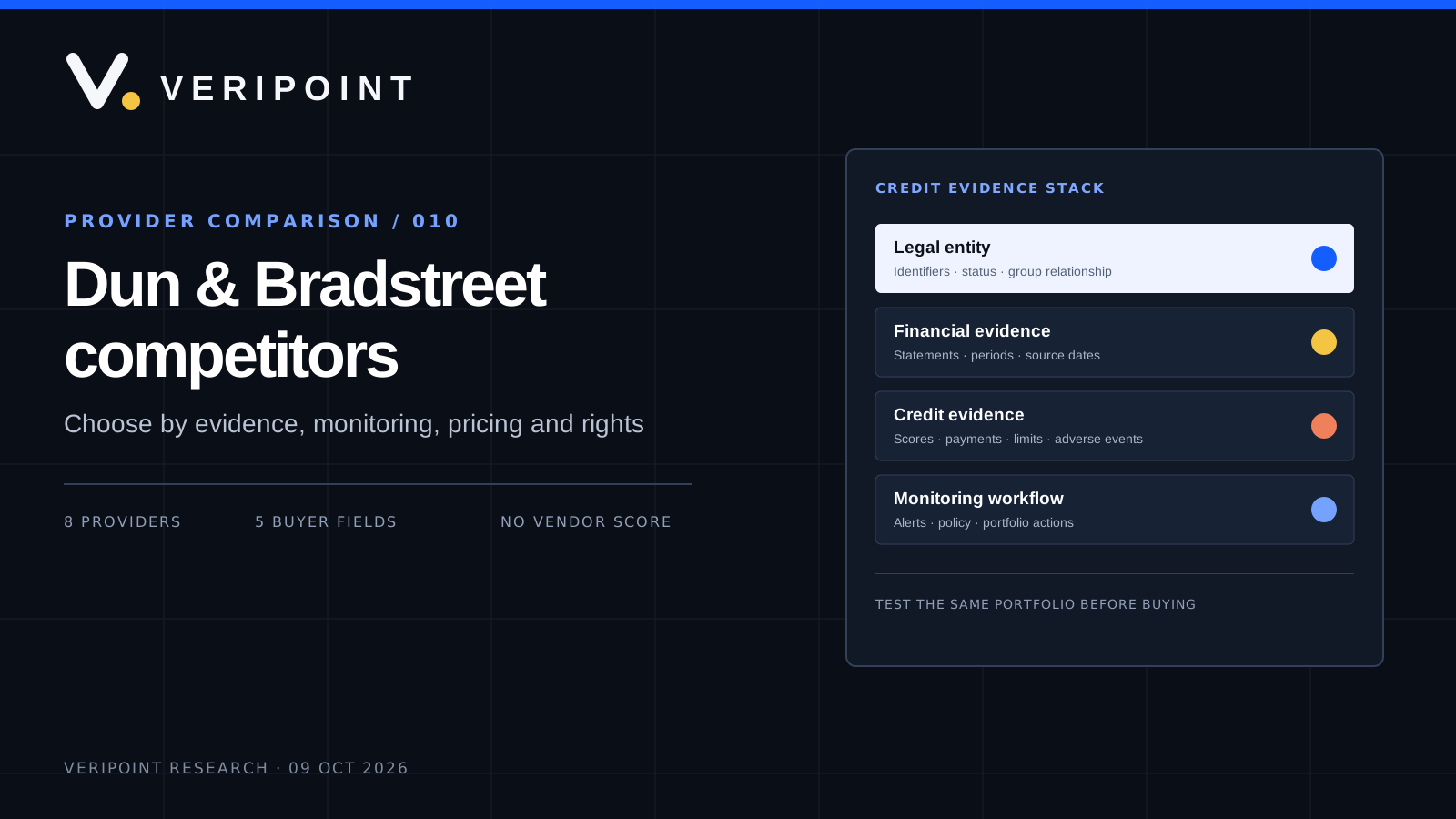
Dun & Bradstreet competitors are not interchangeable credit bureaus. The shortlist spans commercial credit reports, private-company financials, registry data and guided research. The right choice depends on whether the decision is a credit limit, a supplier alert, a financial analysis, a legal-entity match or an embedded data product.
D&B remains a credible incumbent for business identity, credit decisions and portfolio monitoring. Its combination of D-U-N-S identifiers, scores, payment context and Finance Analytics can be difficult to replace with one narrower service. But a team that mainly needs filed financial statements, registry evidence or a small number of company reports may find a focused alternative easier to evaluate and buy.
Choose by the decision, not the database size
Keep D&B when established credit scores, payment context, D-U-N-S identifiers and portfolio workflows are central.
Choose Veripoint for guided company financial analysis with transparent monthly entry pricing.
Choose Global Database when registry, ownership, financial and credit data must connect to API or bulk delivery.
Choose Monetaiq for normalized financial statements through published report-based subscriptions.
Shortlist Creditsafe, Coface or CRIF when specialist commercial-credit reports, monitoring and local risk data drive the decision.
Choose OpenCorporates for registry-grounded legal-entity data—not as a scored credit-report replacement.
Compare the shortlist
Choose by data, workflow and cost. The order is editorial, not a performance ranking. Select a provider to read the full review.
| Provider / focus | Strengths | Limitations | Pricing | Best for |
|---|---|---|---|---|
| Dun & BradstreetCommercial credit, company identity and portfolio risk | Established commercial-credit workflow combining company identity, scores, payment context, monitoring and portfolio analysis. | Pricing is fragmented by product, country, report pack and tier; a public small-business price cannot be applied to an enterprise licence. | USD $139.99 per report; plans from $15/monthChecked 2026-10-09 | Credit and collections teams, supplier-risk programs and enterprises that need commercial-credit decisions, portfolio monitoring and established business identifiers. |
| VeripointGuided company financial research | Combines financial analysis, comparisons, ownership context, saved reports and exports in a guided company-research workflow. | It is not a commercial credit bureau and should not be assumed to provide proprietary trade-payment experience or D&B-specific scores. | USD $99–$499 per monthChecked 2026-10-09 | Analysts, diligence teams and finance or procurement users who want guided financial research with transparent entry pricing and retained reports. |
| Global DatabaseRegistry-led company intelligence, ownership and licensed data | Connects legal-entity, ownership, financial and credit context across online, API and bulk delivery options. | Enterprise pricing is not a single public amount and varies by coverage, seats, exports and selected products. | USD $99/month Regis Pro; enterprise quoteChecked 2026-10-09 | Data teams, compliance and research functions needing registry-led company intelligence, ownership mapping, API or bulk delivery and negotiable usage rights. |
| MonetaiqNormalized private- and public-company financials | Published monthly prices, report allowances and API rate limits make initial budgeting and technical evaluation straightforward. | It is not a bureau-style credit platform with proprietary payment-experience scores or recommended credit limits. | USD $99–$999 per monthChecked 2026-10-09 | Data, fintech and research teams that need structured company statements and ratios through a predictable subscription and API. |
| CreditsafeBusiness credit reports, monitoring and data API | Combines business credit reports, monitoring and API delivery for credit, onboarding and portfolio workflows. | US and UK package pages require a quote, so a buyer cannot calculate total subscription cost from public information alone. | Quote-based; no public USD or GBP amountChecked 2026-10-09 | Commercial credit, onboarding and supplier-risk teams that need multi-country reports, monitoring and a business-data API. |
| Coface Business InformationTrade-credit risk, reports and portfolio monitoring | Business reports combine financial, management, payment-behaviour, score and credit-recommendation context for trade decisions. | Public product pages do not disclose a standard currency amount per report, user or portfolio. | Quote-based; public currency and amount unavailableChecked 2026-10-09 | Trade-credit, collections and supplier-risk teams that value credit recommendations, payment-risk context and portfolio monitoring. |
| CRIFBusiness information, credit analytics and decision support | Broad business-information proposition covering company reports, payment behaviour, financial health, ratings, analytics and portfolio risk. | The exact CRIF product, bureau data and permissible use depend on country and legal context, so global claims do not replace local scoping. | Quote-based; no public standard currency amountChecked 2026-10-09 | Banks, lenders and multinational risk teams seeking locally informed business data, credit analytics and decision-support services. |
| OpenCorporatesLegal-entity registry data and API access | Direct focus on legal entities, registered identifiers and official public-record provenance across many jurisdictions. | Registry data is not a substitute for bureau scores, trade-payment behaviour, recommended credit limits or portfolio decisioning. | GBP £225/month or £2,250/yearChecked 2026-10-09 | Onboarding, compliance and data teams that need registry-grounded legal-entity resolution through an API or selected bulk jurisdictions. |
Separate five product categories before comparing vendors
A commercial credit report supports a decision about whether to extend credit, trade with a company or monitor exposure. It may include payment behaviour, a score, a recommended limit, adverse events and alerts. A private-company financial database starts with filed accounts and normalized statements. It helps answer questions about revenue, profitability, leverage and liquidity but may not include proprietary trade-payment experience.
Registry data answers a more basic but essential question: which legal entity is this? It can supply registration numbers, status, officers and filings. A public-market terminal focuses on securities, prices, estimates, news, transactions and investment workflows. A private-capital intelligence platform focuses on deals, funds, investors and financing history. The last two may be valuable company-research tools, but they are usually poor substitutes for a supplier credit process.
For the underlying analytical work, use Veripoint’s guides to finding private-company financial statements and supplier financial risk assessment. They show why legal-entity matching, filing scope and missing data should be settled before a score or ratio is interpreted.
What each product category is designed to answer
Buyer searches mix competitor, alternative and pricing intent
Semrush data for 9 October 2026 shows that the brand-comparison query is more visible in the United States than the United Kingdom. Pricing and abbreviated “D&B” searches also matter. The values are estimates for separate markets, not traffic forecasts, and missing rows are not treated as zero demand.
Monthly US and UK keyword estimates
Eight Dun & Bradstreet providers compared
The order is editorial, not a score: the featured competitor first, followed by Veripoint, Global Database and Monetaiq, then four rotating providers. Product scope and pricing were checked against official pages on 9 October 2026. A public per-report price is shown only for the named product and market; it is never stretched into an enterprise-platform estimate.
Commercial credit, company identity and portfolio risk
Dun & Bradstreet
Dun & Bradstreet is the featured incumbent. Its business-information products span D-U-N-S identifiers, business credit reports, payment and failure indicators, Finance Analytics, portfolio monitoring and enterprise data delivery. It is strongest when a credit team needs a repeatable counterparty-risk process rather than only filed accounts or a public-markets workstation.
Strengths
- Established commercial-credit workflow combining company identity, scores, payment context, monitoring and portfolio analysis.
- D&B Finance Analytics supports policy-based credit decisions, account prioritisation and alerts across a customer portfolio.
- Public US prices exist for selected small-business reports and subscriptions, giving buyers concrete entry points before an enterprise discussion.
Limitations
- Pricing is fragmented by product, country, report pack and tier; a public small-business price cannot be applied to an enterprise licence.
- A D&B score or D-U-N-S record does not guarantee complete filed financial statements for every legal entity and jurisdiction.
- Teams focused on normalized statements, registry-only evidence or public-market research may pay for credit features they do not use.
- Pricing
- USD $139.99 per report; plans from $15/month US pricing lists a one-pack Business Information Report Snapshot at $139.99, On Demand at $189.99, Credit Insights Score View at $15/month or $149/year, and Finance Analytics Tier 1 Starter at $1,200/year. Higher tiers and enterprise scope differ.Pricing checked 2026-10-09.
- Best for
- Credit and collections teams, supplier-risk programs and enterprises that need commercial-credit decisions, portfolio monitoring and established business identifiers.
Guided company financial research
Veripoint
Veripoint turns available private- and public-company financial records into a workspace for asking questions, comparing companies, reviewing ratios and retaining completed research. It is designed for buyers who need financial analysis with company and source context, rather than a proprietary bureau score or a full market-data terminal.
Strengths
- Combines financial analysis, comparisons, ownership context, saved reports and exports in a guided company-research workflow.
- Published plan prices and a free allowance let a team test representative entities before negotiating a larger data arrangement.
- Workspace API and MCP access share the plan research allowance, supporting analyst and agent workflows without a separate terminal product.
Limitations
- It is not a commercial credit bureau and should not be assumed to provide proprietary trade-payment experience or D&B-specific scores.
- Financial and ownership depth varies by company, jurisdiction, filing rules and available source records.
- Direct data-provider APIs, custom agents and higher-volume packages are separate commercial arrangements.
- Pricing
- USD $99–$499 per month Pro is $99/month for 100 searches, Business $199/month for 300, and Enterprise $499/month for 1,000. Annual billing is 15% lower. A free allowance is available; taxes may apply.Pricing checked 2026-10-09.
- Best for
- Analysts, diligence teams and finance or procurement users who want guided financial research with transparent entry pricing and retained reports.
Registry-led company intelligence, ownership and licensed data
Global Database
Global Database combines company identity, ownership, corporate linkages, financials, credit information and contact data across an online platform, APIs and bulk files. Regis provides a lower-friction research interface, while enterprise licences support broader markets, users, exports and negotiated usage rights.
Strengths
- Connects legal-entity, ownership, financial and credit context across online, API and bulk delivery options.
- Regis publishes a free tier and a $99 monthly Pro plan, while enterprise buyers can scope markets and rights separately.
- A good fit when registry provenance, group structures and operational data delivery matter alongside company research.
Limitations
- Enterprise pricing is not a single public amount and varies by coverage, seats, exports and selected products.
- The broad product family requires a precise data dictionary and contract scope; Regis credits are not the same unit as enterprise records or reports.
- Financial history and fields vary with jurisdictional disclosure and source availability.
- Pricing
- USD $99/month Regis Pro; enterprise quote Regis Pro publishes $99/month for 200 credits; annual billing shows two months free. The enterprise online platform is usually licensed for one year and priced by coverage, users and exports; credit reports and enrichment can use different units.Pricing checked 2026-10-09.
- Best for
- Data teams, compliance and research functions needing registry-led company intelligence, ownership mapping, API or bulk delivery and negotiable usage rights.
Normalized private- and public-company financials
Monetaiq
Monetaiq is a focused financial-data service for normalized balance sheets, income statements, cash-flow data, ratios and filing history. Published plans are measured by full company financial reports, which makes its volume economics easier to inspect than quote-only enterprise credit platforms.
Strengths
- Published monthly prices, report allowances and API rate limits make initial budgeting and technical evaluation straightforward.
- Every plan includes normalized statements, ratios and filing history; higher plans add monitoring.
- Bulk files, original filings, longer workflows and redistribution can be separately scoped when subscriptions are insufficient.
Limitations
- It is not a bureau-style credit platform with proprietary payment-experience scores or recommended credit limits.
- Monitoring is limited to Business and Scale, and subscription rights cover internal use rather than customer redistribution.
- Coverage depth depends on what registries and exchanges disclose, so country and entity samples still require testing.
- Pricing
- USD $99–$999 per month Starter is $99/month for 200 reports, Growth $199 for 600, Business $499 for 3,000 and Scale $999 for 10,000. Annual billing is 15% lower; unused reports do not roll over.Pricing checked 2026-10-09.
- Best for
- Data, fintech and research teams that need structured company statements and ratios through a predictable subscription and API.
Business credit reports, monitoring and data API
Creditsafe
Creditsafe provides company credit reports, scores and limits, financial and payment data, monitoring, compliance information and the Creditsafe Connect API. It is a direct D&B shortlist candidate for commercial credit and supplier-risk use cases, particularly when multi-country reports and workflow integration matter.
Strengths
- Combines business credit reports, monitoring and API delivery for credit, onboarding and portfolio workflows.
- Creditsafe Connect describes company, financial, payment, director, shareholder, linkage and compliance data through one integration.
- Published package descriptions make report and monitoring allowances visible even though the final price requires a quote.
Limitations
- US and UK package pages require a quote, so a buyer cannot calculate total subscription cost from public information alone.
- Score definitions, data fields and monitoring availability can differ across countries and must be tested market by market.
- Its credit focus does not replace a public-market terminal or a dedicated transaction and private-capital database.
- Pricing
- Quote-based; no public USD or GBP amount US Standard, Plus and Premier credit-report packages and UK regional packages direct buyers to request a quote. Creditsafe Connect API is also sold through a sales discussion. Confirm currency, users, report allowances, monitoring entities and API units.Pricing checked 2026-10-09.
- Best for
- Commercial credit, onboarding and supplier-risk teams that need multi-country reports, monitoring and a business-data API.
Trade-credit risk, reports and portfolio monitoring
Coface Business Information
Coface Business Information applies the company and payment-risk expertise of a global trade-credit insurer to business reports, credit opinions, scores, monitoring, APIs and the Urba360 platform. It is relevant when the decision is whether and how much to trade with a counterparty, not when the primary task is securities research.
Strengths
- Business reports combine financial, management, payment-behaviour, score and credit-recommendation context for trade decisions.
- Urba360 and APIs support consistent monitoring of business partners across an international portfolio.
- Buyers can choose individual insight services or a broader platform and licensing arrangement.
Limitations
- Public product pages do not disclose a standard currency amount per report, user or portfolio.
- Coface credit opinions and insurer-informed risk signals are not directly interchangeable with D&B or Creditsafe scores.
- It is not designed to replace consensus estimates, market data, trading tools or private-capital deal intelligence.
- Pricing
- Quote-based; public currency and amount unavailable Coface offers individual reports, credit opinions, Urba360 licences and APIs, but its official business-information pages ask buyers to get in touch. Request price per report or licensed user, monitored entities, API units, countries, term and renewal.Pricing checked 2026-10-09.
- Best for
- Trade-credit, collections and supplier-risk teams that value credit recommendations, payment-risk context and portfolio monitoring.
Business information, credit analytics and decision support
CRIF
CRIF supplies business information, credit-bureau services, ratings, analytics and decision-support capabilities across local markets, with SkyMinder extending access to global company reports. It suits buyers that need a credit-information partner able to combine local sources with risk, compliance and workflow tools.
Strengths
- Broad business-information proposition covering company reports, payment behaviour, financial health, ratings, analytics and portfolio risk.
- Local-market operations and the SkyMinder ecosystem support cross-border company investigation and credit decisions.
- Relevant beyond a single report when credit, fraud, compliance and automated decisioning need to connect.
Limitations
- The exact CRIF product, bureau data and permissible use depend on country and legal context, so global claims do not replace local scoping.
- No standard global public subscription or per-report price is shown on the official business-information page.
- A broad risk and decisioning engagement may be more complex than a team needs for occasional financial-statement research.
- Pricing
- Quote-based; no public standard currency amount CRIF publishes business-information capabilities but not one global price. Obtain a local proposal stating currency, users, countries, reports, portfolio size, API or decisioning units, implementation, data rights and term.Pricing checked 2026-10-09.
- Best for
- Banks, lenders and multinational risk teams seeking locally informed business data, credit analytics and decision-support services.
Legal-entity registry data and API access
OpenCorporates
OpenCorporates aggregates official company-registry records into searchable legal-entity data and commercial APIs or bulk delivery. It is useful for entity resolution, onboarding, investigations and registry provenance. It is included here to show where registry evidence fits—and where it does not replace a scored credit report.
Strengths
- Direct focus on legal entities, registered identifiers and official public-record provenance across many jurisdictions.
- Published self-serve API prices expose currency, billing basis and call allowances without a sales process.
- Commercial plans permit internal and external use, while enterprise buyers can scope jurisdictions and bulk delivery.
Limitations
- Registry data is not a substitute for bureau scores, trade-payment behaviour, recommended credit limits or portfolio decisioning.
- The £225 monthly entry plan includes only 500 API calls per month and 200 per day, so production economics need careful modelling.
- Financial-statement depth and officer or filing availability follow the underlying registry and should not be assumed uniform.
- Pricing
- GBP £225/month or £2,250/year Essentials includes up to 500 API calls/month and 200/day. Starter is £660/month or £6,600/year for 2,500 calls/month; Basic is £1,200/month or £12,000/year for 5,000. Bulk and bespoke API access are quote-based.Pricing checked 2026-10-09.
- Best for
- Onboarding, compliance and data teams that need registry-grounded legal-entity resolution through an API or selected bulk jurisdictions.
Pricing visibility is part of the procurement risk
Published entry pricing makes a pilot easier to budget, but it does not prove lower total cost. Quote-based platforms can include reports, monitoring, onboarding or support that a narrow subscription prices separately. Conversely, a broad credit licence can be wasteful when most users only retrieve statements or resolve legal entities.
The current product direction is also clear: the specialist vendors increasingly connect a company report to portfolio monitoring, APIs and automated decision support, while registry and financial-data providers expose more self-serve entry plans. That changes the procurement question from “which report is best?” to “which evidence, update event and usage right fits the operating workflow?” The shift does not remove the need to validate local data sources and contract terms.
How each shortlisted provider can be bought
Run a credit-data test before negotiating the contract
A vendor demonstration normally uses clean, high-information companies. A credible test uses your customer or supplier portfolio, including ambiguous names, thin files, subsidiaries, small private companies and entities in the countries where exposure is highest. Lock the sample and required outputs before any provider returns results.
For each company, record whether the correct legal entity matched; the identifier and group relationship; which financial periods and fields are available; the source and filing date; which payment, score and adverse-event fields exist; and whether the monitoring event arrives in time to change a decision. A missing value that is clearly labelled can be safer than a confident-looking value with unclear provenance.
A 100-point buyer-set evaluation
1. Define the decision. Credit approval, supplier monitoring, financial analysis and entity resolution need different evidence.
2. Freeze the portfolio. Include easy matches, known failures, subsidiaries, inactive entities and several jurisdictions.
3. Freeze the dictionary. State required fields, history, currency, consolidation basis, null rules and alert events.
4. Test explanations. Require score factors, source dates, update triggers and a path to challenge incorrect data.
5. Test delivery and rights. Check API limits, exports, derived outputs, model use, redistribution, retention and deletion.
6. Price the complete term. Include users, reports, monitored entities, implementation, overages, renewal and exit.
Four buyer objections that should not be ignored
“The score is not explainable enough.” A credit score can improve consistency, but the user must know which entity, reporting date and signals it reflects. Ask how overrides, stale data, thin files and disputes are handled. A recommendation without an audit trail may be difficult to defend to a credit committee or supplier owner.
“The global coverage claim does not match our portfolio.” Provider universes use different definitions and may count legal entities without the specific accounts, payment data or monitoring events you need. Report match rate and required-field completeness on your sample, by country and entity type. Do not use a headline company count as a quality score.
“The contract blocks our intended use.” Screen access, API retrieval, internal analytics, model training, customer-facing display and redistribution are different rights. Confirm what can be stored, transformed, displayed and retained after termination. A technically suitable API can still be unusable if the licence does not permit the production workflow.
“Switching risk is larger than the saving.” Existing identifiers, policy rules, watchlists, integrations and analyst habits have migration value. Compare the complete operating change, not just subscription price. A two-provider design can be sensible when one source handles credit monitoring and another handles financial analysis, provided the entity-matching and rights are explicit.
Replace a defined credit-data workflow, not a familiar brand
Document the decision, portfolio, evidence fields, update events and rights that matter. Then require two or three providers to return the same test. Keep D&B where its credit and identity ecosystem is productive; choose a focused alternative where it produces the required evidence with clearer scope or a better-fit workflow.
Analyse one company in Veripoint.
Use a real customer or supplier, inspect the available financial and ownership context, and compare the evidence with your current credit-data process before selecting a larger plan.
Analyse a companyProduct scope and pricing status were checked against official vendor pages on 9 October 2026. Public prices apply only to the named currency, product, unit and billing basis. Financial, credit and ownership availability varies by entity, market, source and filing regime.
Dun & Bradstreet competitors FAQs
01What are the best Dun & Bradstreet competitors?
The best Dun & Bradstreet competitor depends on the decision. Veripoint is suited to guided company financial analysis, Global Database to registry-led company intelligence and licensed data delivery, Monetaiq to normalized financial statements, Creditsafe and Coface to commercial credit workflows, CRIF to market-specific business information and decisioning, and OpenCorporates to legal-entity registry data. None is a universal substitute for every D&B product.
02What is the best D&B alternative for a small business?
A small business should start with the narrowest requirement. A single D&B Business Information Report may suit an occasional US counterparty check. Veripoint offers a free allowance and published monthly plans for company financial research; Global Database Regis publishes a $99 monthly Pro plan; Monetaiq starts at $99 per month for structured financial reports; OpenCorporates starts at £225 per month for API access. Credit-report providers generally require a quote, so compare the actual annual commitment and report allowance.
03How much does Dun & Bradstreet cost?
D&B pricing varies by product. On 9 October 2026, its US small-business schedule listed a Business Information Report Snapshot at $139.99 for one report, On Demand at $189.99 for one report, Credit Insights Score View at $15 per month or $149 per year, and Finance Analytics Tier 1 Starter at $1,200 per year. Higher tiers and enterprise configurations use different prices and scope, so these figures should not be extrapolated to every D&B product or country.
04Is Creditsafe better than Dun & Bradstreet?
Neither is categorically better. Creditsafe is a credible shortlist option for company credit reports, monitoring, international data and API access. D&B has its D-U-N-S identifier, PAYDEX and other risk products within a broad commercial-data ecosystem. Test both on the same customers or suppliers, then compare entity matching, financial depth, payment data, score explanations, monitoring events, integration rights and total contracted price.
05Can Veripoint replace D&B for company research?
Veripoint can replace or complement a D&B workflow when the main job is analysing available private- or public-company financial records, comparing companies and keeping an evidence-aware report. It is not positioned as a credit bureau, a payment-experience exchange or a real-time public-market terminal. Buyers that require proprietary trade-payment data, a particular bureau score or automated credit policy should retain a specialist credit provider or test a combined stack.
06Which D&B competitor is best for private-company financials?
Veripoint and Monetaiq are focused options when the core requirement is company financial analysis or normalized statements. Global Database combines financials with company identity, ownership and credit information. Creditsafe, Coface and CRIF add credit-risk context, while OpenCorporates is primarily a legal-entity registry source rather than a normalized financial database. In every case, validate the required jurisdictions, years, statement fields, consolidation basis and source dates.
07Which business credit report provider is best for supplier risk?
For supplier risk, prioritize coverage of the actual supplier portfolio, clear risk explanations, monitoring events, financial and payment indicators, group links and an escalation workflow. D&B, Creditsafe, Coface and CRIF are all relevant specialist candidates. Veripoint can add financial-statement analysis, but it should not be treated as a substitute for proprietary payment behaviour or bureau-specific scores. Run a blind test using real suppliers, including known weak and ambiguous cases.
08Is OpenCorporates a free alternative to D&B?
OpenCorporates provides useful public access to legal-entity records, but its commercial API plans are paid and it is not a like-for-like credit intelligence service. It helps answer whether a company exists, its registered identifiers, officers and filings where available. It does not by itself supply the full credit scores, payment behaviour, recommended limits, monitoring and decisioning associated with a commercial credit platform.
09What should procurement test before buying a D&B alternative?
Use a representative sample of customers, suppliers and subsidiaries across the countries and risk bands that matter. Measure correct legal-entity matching, financial-field completeness, payment and score availability, source dates, group relationships, alerts, export and API behaviour, usage rights and support. Price the complete three-year term, including seats, report packs, monitoring portfolios, API calls, implementation, overages, renewal and exit obligations.
10Do Dun & Bradstreet alternatives offer APIs and monitoring?
Several do, but the products and rights differ. Global Database offers APIs and bulk delivery under commercial terms; Monetaiq publishes API limits and includes monitoring on higher plans; Creditsafe Connect provides business and credit data by API; Coface offers API access and portfolio monitoring through Urba360; CRIF supplies business-information and decision-support services; OpenCorporates publishes self-serve API plans. Confirm refresh triggers, rate limits, historical access, redistribution rights and post-termination retention in writing.