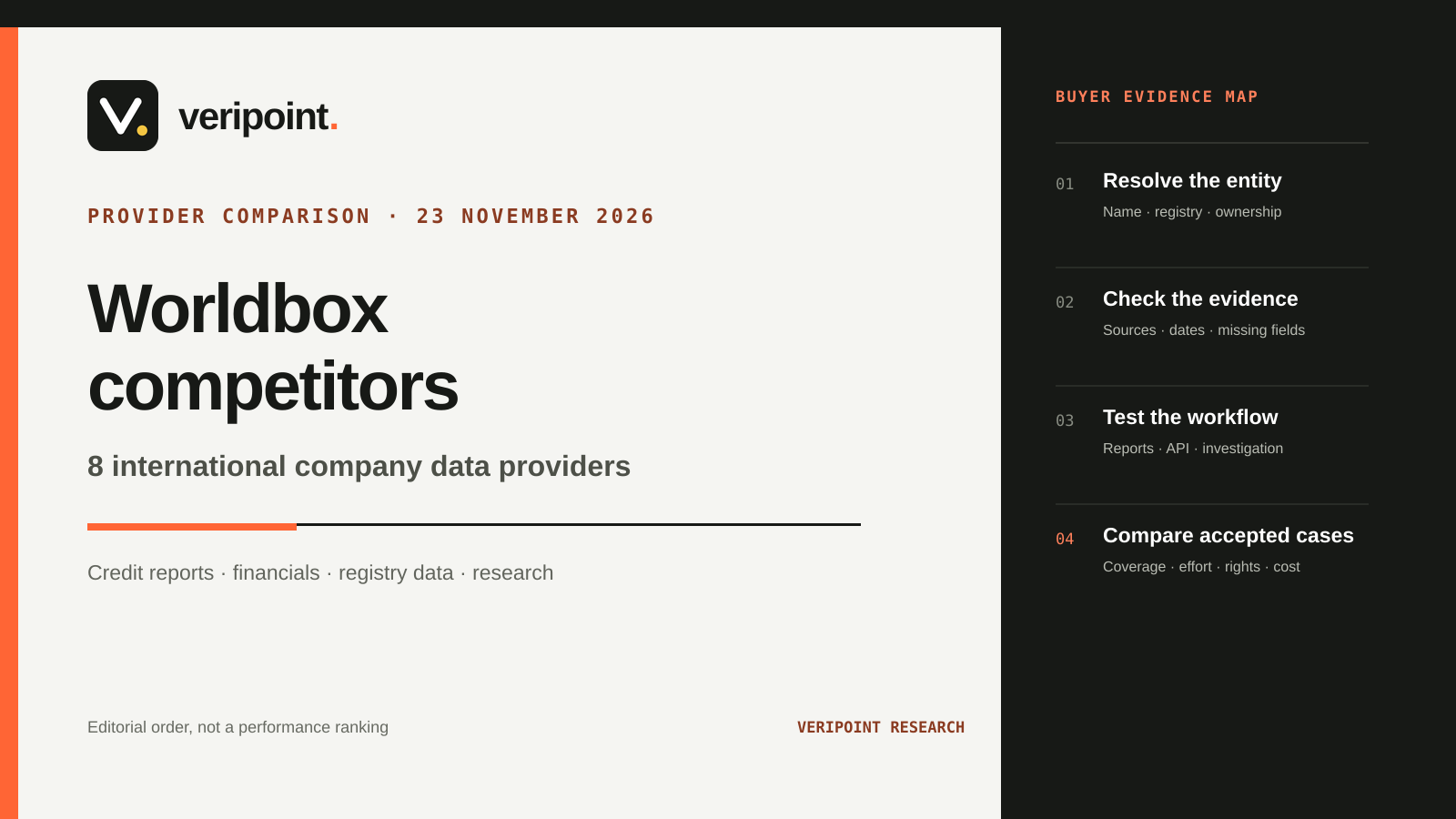
Worldbox competitors should be compared against the exact country, entity and evidence required. Worldbox combines a searchable global company dataset with credit reports, original registry documents, ownership research and local investigation. Veripoint, Global Database and Monetaiq cover narrower financial and registry workflows. Dun & Bradstreet brings multinational commercial-credit operations; Moody’s Orbis standardizes global company reference data; OpenCorporates aggregates legal-entity records; and EMIS adds emerging-market company and industry context. These products overlap, but they are not interchangeable.
Choose the missing evidence layer, not the largest database
Keep Worldbox on the shortlist when difficult international entities require investigated reports, original documents, ownership research or a fresh local check.
Choose Veripoint for explained analysis when the legal entity, period, currency, units, calculations and evidence gaps must remain reviewable.
Choose Global Database or Monetaiq when registry identity, ownership, filed accounts or normalized financial delivery is the primary requirement.
Shortlist Dun & Bradstreet when commercial-credit monitoring, identifiers, portfolio analytics and decision workflow matter at multinational scale.
Shortlist Moody’s Orbis or OpenCorporates when standardized company reference data or registry-led entity resolution is more important than an investigated credit opinion.
Shortlist EMIS when company research must sit beside emerging-market industry, country, news and deal context.
Commercial disclosure: Veripoint is by Global Database. Monetaiq’s legal footer identifies Global Data Intelligence Limited, the same company behind Global Database. They are affiliated products with different workflows, not three independent endorsements. The order follows this series’ editorial format and is not an objective ranking or independent product test.
Compare the shortlist
Choose by data, workflow and cost. The order is editorial, not a performance ranking. Select a provider to read the full review.
| Provider / focus | Strengths | Limitations | Pricing | Best for |
|---|---|---|---|---|
| WorldboxInternational company credit reports, registry documents, ownership research and investigated business intelligence | Worldbox combines standardized online records with freshly obtained registry documents and human investigation when a ready-made file is insufficient. | Financial, payment and ownership fields are included only where available, so country and entity testing is more important than the headline database size. | Unit-based or bespoke; public current amount unavailableChecked 2026-11-23 | International credit, trade, compliance and due-diligence teams that need investigated company reports or official documents in difficult and long-tail jurisdictions. |
| VeripointEvidence-aware private- and public-company financial research with reviewable analysis | Research keeps entity, reporting basis, calculations and source limitations together instead of compressing the decision into an unexplained score. | Veripoint is not a commercial credit bureau, formal rating agency, insurer or substitute for Worldbox payment intelligence and bespoke investigation. | Free; USD 99, USD 199 or USD 499 per monthChecked 2026-11-23 | Finance, investment, lending, procurement and corporate-development analysts who need explained company-financial research with visible evidence boundaries. |
| Global DatabaseRegistry-led legal-entity identity, ownership, filed financials and licensed enterprise delivery | Registry-led identifiers and sources help distinguish a parent, subsidiary, branch and similarly named company before financial or credit analysis begins. | Registry and filed-company data do not reproduce Worldbox payment experience, investigated commentary or a credit recommendation. | Regis Free or displayed $99/month; Corporate customChecked 2026-11-23 | Risk, compliance and data teams that need sourced legal-entity, ownership and filed-company evidence with contractually defined delivery and usage rights. |
| MonetaiqNormalized private- and public-company financial statements, ratios and volume-based API access | The public price page identifies monthly financial-report allowances, making the primary consumption unit visible before an enterprise sales process. | Normalized accounts do not replace payment behaviour, adverse-event investigation, a bureau score or the buyer’s governed credit policy. | Displayed $99, $199, $499 or $999 per monthChecked 2026-11-23 | Research and data teams that mainly need normalized company accounts with visible report-volume economics and API delivery. |
| Dun & BradstreetGlobal commercial identity, business credit, monitoring, portfolio analytics and decision support | D-U-N-S identifiers and corporate linkage can help normalize counterparties and groups across a multinational portfolio. | Global scale does not guarantee identical payment data, score performance, fields or refresh timing in every country. | Named US plans from USD 1,200 to USD 50,000 per yearChecked 2026-11-23 | Multinational credit teams that need global business identifiers, commercial-credit information, monitoring and portfolio-level analytics. |
| Moody's OrbisGlobal private-company reference data, standardized financials, ownership structures and enterprise integration | Orbis combines global company identities, standardized financials and extensive corporate ownership structures for research and enterprise data management. | A large company count does not reveal required-field completeness, filing depth, freshness or source quality for the buyer’s actual legal entities. | Quote-based; no public standard Orbis amountChecked 2026-11-23 | Enterprise research, master-data, compliance and corporate-finance teams that need standardized global private-company and ownership data. |
| OpenCorporatesLegal-entity and officer data aggregated from official registries with API and bulk delivery | A registry-led model and explicit source provenance help buyers inspect which official register supports a company record. | Registry records answer identity and filing questions but do not provide a complete substitute for Worldbox payment evidence, analyst investigation or credit opinion. | GBP 2,250/year, GBP 6,600/year or GBP 12,000/year; enterprise customChecked 2026-11-23 | KYB, investigations and master-data teams that need transparent registry-led entity resolution through search, API or bulk delivery. |
| EMISEmerging-market company profiles, industry intelligence, country context, news and deal research | Company profiles sit beside emerging-market industry, country, news and deal research, reducing the need to assemble context from unrelated services. | Industry and country research do not replace entity-level payment experience, a credit opinion or a governed counterparty decision. | Named company reports sold in USD; full subscription quote-basedChecked 2026-11-23 | Strategy, investment, corporate-development and risk teams that need emerging-market company evidence connected to industry, country and deal context. |
Start by separating six company-data categories
Investigated business credit reports are assembled for a counterparty decision. Depending on country and product, they can include identity, ownership, financials, payment behaviour, legal events, a score, analyst opinion, recommended limit and monitoring. Worldbox and Dun & Bradstreet operate in this layer, but their workflow differs: Worldbox emphasizes report ordering, original documents and fresh investigation, while D&B emphasizes reusable identifiers, portfolio analytics and decision support. A shared “credit report” label does not guarantee the same sources, fields or model.
Private-company financial platforms start with the correct legal entity and the accounts it was required or chose to file. The critical context is period, filing date, currency, units and standalone or consolidated scope. Veripoint emphasizes explained analysis; Monetaiq emphasizes normalized statement delivery; Global Database and Orbis add company, ownership and filing context. A filed balance sheet is not payment experience, and a credit opinion is not a substitute for reading the underlying accounts.
Registry data answers whether an entity legally exists, how it is registered, who manages or owns it and which filings are available. OpenCorporates is the purest registry-led option in this comparison. Global Database adds registry-based KYB and ownership workflows; Worldbox can order fresh official documents; Orbis standardizes company structures from many sources. Registry evidence can establish identity and lineage, but it does not by itself establish willingness or ability to pay.
Company-reference platforms normalize identities, financials, ownership structures and group relationships for search and integration. Moody’s Orbis is designed around this persistent reference layer. It can support compliance, master data, supplier risk, finance and credit research, but a standardized row is not the same deliverable as a locally investigated report. Buyers should decide whether they need a repeatable database, an evidential document or both.
Industry and market intelligence explains the operating environment around a company. EMIS connects company profiles to emerging-market sectors, country developments, news and deals. That context can improve a risk or investment memo, yet it does not automatically supply a payment pool, a formal credit recommendation or the latest registry extract. Public-market terminals and private-capital intelligence also sit in adjacent categories: terminals organize prices, estimates and news, while private-capital platforms focus on funds, investors and transactions.
Decisioning, ratings, insurance and collections are separate services. A workflow engine applies rules and manages overrides; a formal rating is issued under a named methodology and surveillance process; insurance transfers only risks accepted under a policy; and collection begins after a debt is overdue. A company-data score can be a useful input without becoming any of those products. Procurement should name the responsible legal entity, permitted purpose, method, output and recourse instead of relying on a broad platform label.
For adjacent categories, see the Bloomberg Terminal alternatives, PitchBook competitors and OpenCorporates competitors guides. Those pages own terminal, private-capital and registry-first intent, which avoids turning this Worldbox comparison into an unfocused list of every company-data product.
Eight Worldbox competitors reviewed by buyer fit
Official product, pricing and development pages were checked independently on 23 November 2026. The table and detailed reviews use the identical eight-provider collection and order. Quote-only products remain quote-only. Published amounts apply only to the named product, currency, unit and billing basis. A D&B US list price, an OpenCorporates API plan or an EMIS store report is not presented as the price of another enterprise service. Unavailable prices are never plotted as zero.
International company credit reports, registry documents, ownership research and investigated business intelligence
Worldbox
Worldbox is the featured provider because it combines searchable company data with corporate, relation and financial reports, original registry documents, UBO analysis and bespoke investigation. Its corporate reports can draw on official sources, media research, interviews and local investigators, then add available financials, payment information, a 1–20 credit rating and analyst commentary. That model is useful for difficult international entities, but “worldwide” does not mean every record is instant, equally complete or fit for the same decision.
Strengths
- Worldbox combines standardized online records with freshly obtained registry documents and human investigation when a ready-made file is insufficient.
- Company, relation, financial and UBO report types address identity, ownership, group links, available financials, payment information and credit opinion in one supplier relationship.
- Online search, API, MCP and marketplace delivery give buyers several procurement and integration paths, subject to the selected product and contract.
Limitations
- Financial, payment and ownership fields are included only where available, so country and entity testing is more important than the headline database size.
- Fresh investigation can add context but may take longer than an instant lookup and needs explicit source-date, turnaround and acceptance rules.
- Official pages describe a current price list, advance payment, unit-based purchase and bespoke offers without exposing one universal public currency amount or unit value.
- Pricing
- Unit-based or bespoke; public current amount unavailable Worldbox’s terms say services follow the current price list, generally use advance payment by card or invoice, and may receive high-volume offers. Its MCP announcement describes per-product unit pricing. The public pages reviewed did not expose a universal currency amount, report-unit value, user fee, billing period or enterprise term. Require the country, named report, investigation turnaround, units, API or MCP access, data rights, currency, tax, prepaid-credit expiry, renewal and termination in writing.Pricing checked 2026-11-23.
- Best for
- International credit, trade, compliance and due-diligence teams that need investigated company reports or official documents in difficult and long-tail jurisdictions.
Evidence-aware private- and public-company financial research with reviewable analysis
Veripoint
Veripoint resolves the legal entity, retrieves available company financial and ownership evidence, compares periods and produces explained research. It fits buyers whose Worldbox comparison is really about understanding financial performance rather than ordering a credit opinion or an investigated registry document. The legal entity, reporting period, filing date, currency, units, accounting scope, calculations and missing evidence remain beside the conclusion, which helps an analyst review rather than merely consume the output.
Strengths
- Research keeps entity, reporting basis, calculations and source limitations together instead of compressing the decision into an unexplained score.
- Available private- and public-company records can be reviewed in one workflow, with mismatched periods, currencies and scopes retained as limitations.
- Published USD plans and a Free tier let buyers test representative companies before separately scoping provider APIs, bulk data or custom delivery.
Limitations
- Veripoint is not a commercial credit bureau, formal rating agency, insurer or substitute for Worldbox payment intelligence and bespoke investigation.
- Financial, ownership and history availability depends on the exact legal entity, jurisdiction, filing regime and underlying source publication.
- Workspace subscriptions do not automatically include direct-provider APIs, bulk raw data, redistribution rights or every original registry document.
- Pricing
- Free; USD 99, USD 199 or USD 499 per month Prices are USD before tax, billed monthly: Pro includes 100 completed searches, Business 300 and Enterprise 1,000. Annual charges are USD 1,009.80, USD 2,029.80 and USD 5,089.80 after the published 15% annual discount. Free includes three completed searches per day. Business and Enterprise add daily monitoring for up to 25 and 100 companies. Direct-provider APIs, bulk files and custom feeds are separately scoped.Pricing checked 2026-11-23.
- Best for
- Finance, investment, lending, procurement and corporate-development analysts who need explained company-financial research with visible evidence boundaries.
Registry-led legal-entity identity, ownership, filed financials and licensed enterprise delivery
Global Database
Global Database combines company identifiers, registry evidence, directors, shareholders, group structures and filed financials through Regis, its wider company platform, APIs and bulk services. It is relevant when a Worldbox buyer mainly needs to resolve and enrich a legal entity or license a defined dataset rather than commission a fresh credit investigation. Registry evidence can strengthen a counterparty file, but it does not recreate Worldbox analyst interviews, payment experience or credit opinions.
Strengths
- Registry-led identifiers and sources help distinguish a parent, subsidiary, branch and similarly named company before financial or credit analysis begins.
- Regis combines sourced identity, available financials, officers, shareholders and group information in a research interface with published entry pricing.
- Corporate delivery can include KYB, ownership, directors, financials, linkage, APIs, bulk files and commercial licensing for defined enterprise uses.
Limitations
- Registry and filed-company data do not reproduce Worldbox payment experience, investigated commentary or a credit recommendation.
- Filed accounts, ownership disclosure, original documents and refresh timing vary by jurisdiction, entity and registry rules.
- The displayed Regis price is not a quote for Corporate API, bulk delivery, redistribution, unlimited users or every Global Database dataset.
- Pricing
- Regis Free or displayed $99/month; Corporate custom The official Regis page displays Free with five credits per month and Pro at $99 per month, billed monthly, with 200 credits. The page shows a dollar sign without an explicit currency code, so settlement currency and tax must be confirmed. Free and Pro are view-only for CSV/PDF and exclude API access. Corporate downloads, API, bulk delivery, unlimited seats and lookups, redistribution and commercial licensing are quote-based.Pricing checked 2026-11-23.
- Best for
- Risk, compliance and data teams that need sourced legal-entity, ownership and filed-company evidence with contractually defined delivery and usage rights.
Normalized private- and public-company financial statements, ratios and volume-based API access
Monetaiq
Monetaiq concentrates on structured company accounts: balance sheets, income statements, cash flow, ratios and filing history. It is relevant when the missing layer is repeatable financial retrieval for internal screening, modelling or software rather than a Worldbox credit report, payment history or local investigation. Searches and identifier lookups are free; the published monthly allowance is consumed when the user retrieves a company’s full financial record.
Strengths
- The public price page identifies monthly financial-report allowances, making the primary consumption unit visible before an enterprise sales process.
- Statements and ratios are normalized into a repeatable schema and retain source and filing-date context for available records.
- Business and Scale include monitoring, while bulk statements, original filings, redistribution and higher-volume delivery can be separately scoped.
Limitations
- Normalized accounts do not replace payment behaviour, adverse-event investigation, a bureau score or the buyer’s governed credit policy.
- Coverage and history vary by entity and filing regime; one complete record does not promise the same fields or years for the next company.
- The public plan cards and detailed table publish different daily API limits, so throughput must be resolved in writing before purchase.
- Pricing
- Displayed $99, $199, $499 or $999 per month The official page displays Starter, Growth, Business and Scale at $99, $199, $499 and $999 per month with 200, 600, 3,000 and 10,000 financial reports. It advertises 15% off annual billing. The page uses dollar signs without an explicit currency code, so settlement currency and tax must be confirmed. Monthly allowances reset; bulk files, original filings, redistribution and higher limits are separate. Confirm the daily API limit because the plan cards and detailed table conflict.Pricing checked 2026-11-23.
- Best for
- Research and data teams that mainly need normalized company accounts with visible report-volume economics and API delivery.
Global commercial identity, business credit, monitoring, portfolio analytics and decision support
Dun & Bradstreet
Dun & Bradstreet Finance Analytics combines business identity, D-U-N-S identifiers, corporate linkage, scores, payment information, monitoring and portfolio analytics. It is relevant when an international credit team needs a repeatable commercial-credit workflow rather than Worldbox’s report-plus-investigation model. D&B also publishes US prices for named Finance Analytics tiers, but those amounts should not be treated as the price of a multinational enterprise implementation.
Strengths
- D-U-N-S identifiers and corporate linkage can help normalize counterparties and groups across a multinational portfolio.
- Finance Analytics connects company research, risk indicators, monitoring, portfolio prioritization and decision support in one commercial-credit proposition.
- The official US schedule publishes annual prices for named Finance Analytics Tier 1 offers, giving buyers a concrete unit to compare.
Limitations
- Global scale does not guarantee identical payment data, score performance, fields or refresh timing in every country.
- A score or recommended limit remains an input to the buyer’s policy and must be considered beside exposure, concentration, security and current financial evidence.
- US list prices do not establish countries, users, implementation, taxes, renewal, rights or the final cost of a multinational configuration.
- Pricing
- Named US plans from USD 1,200 to USD 50,000 per year The official US small-business schedule lists D&B Finance Analytics Tier 1 Starter at USD 1,200 per year and named tiers up to Titanium at USD 50,000 per year. These are annual list prices for named US offers, not a universal global tariff. Require countries, users, reports, monitored entities, decisioning, MCP or API access, implementation, support, taxes, annual uplift, renewal and data rights in a dated proposal.Pricing checked 2026-11-23.
- Best for
- Multinational credit teams that need global business identifiers, commercial-credit information, monitoring and portfolio-level analytics.
Global private-company reference data, standardized financials, ownership structures and enterprise integration
Moody's Orbis
Moody’s Orbis is a company-reference platform rather than a report bureau. It standardizes company identities, financials, hierarchies and ownership structures for search, comparison and integration. That makes it relevant when the Worldbox alternative requirement is a persistent global company master or comparable private-company dataset. It is less direct when the buyer specifically needs freshly investigated payment experience, a recommended credit opinion or a named official document.
Strengths
- Orbis combines global company identities, standardized financials and extensive corporate ownership structures for research and enterprise data management.
- Web interfaces, APIs, feeds and connectors support analyst use and integration into master-data, compliance, risk and finance workflows.
- Moody’s identifies the July 2026 reference date for its published company and source counts, giving procurement a dated provider claim to test.
Limitations
- A large company count does not reveal required-field completeness, filing depth, freshness or source quality for the buyer’s actual legal entities.
- Standardized company reference data does not automatically replace Worldbox investigated commentary, payment experience or a report-level credit opinion.
- The official Orbis page asks buyers to contact a specialist and publishes no standard currency amount, user unit, billing period or contract term.
- Pricing
- Quote-based; no public standard Orbis amount The official Orbis page directs buyers to talk to a Moody’s specialist or book a demo. It publishes no standard USD, GBP or EUR amount, named-user price, API unit, billing period or contract term. Require countries, entities, historical depth, ownership modules, web users, API or feed volumes, source documents, implementation, service levels, tax, renewal, price uplift, data retention and exit rights in a dated quote.Pricing checked 2026-11-23.
- Best for
- Enterprise research, master-data, compliance and corporate-finance teams that need standardized global private-company and ownership data.
Legal-entity and officer data aggregated from official registries with API and bulk delivery
OpenCorporates
OpenCorporates is a registry-data specialist. It aggregates legal-entity and officer records from government registers into a standardized schema and provides search, API and bulk access. It is useful when the Worldbox comparison is mainly about confirming that a company exists, resolving the correct legal entity, tracking registry changes or building an entity spine. It does not itself reproduce a researched credit report, payment history, analyst credit opinion or normalized multi-statement financial model.
Strengths
- A registry-led model and explicit source provenance help buyers inspect which official register supports a company record.
- Self-serve commercial API plans publish GBP prices, monthly call allowances and internal or external use rights.
- API and bulk delivery support entity resolution, onboarding, investigations and master-data workflows without implying a broader credit bureau product.
Limitations
- Registry records answer identity and filing questions but do not provide a complete substitute for Worldbox payment evidence, analyst investigation or credit opinion.
- Register openness, update timing, fields and officer disclosure differ materially by jurisdiction, so global aggregation still requires source-level testing.
- Self-serve API allowances are low relative to many enterprise workloads, while bulk delivery and bespoke API access require a separate quote.
- Pricing
- GBP 2,250/year, GBP 6,600/year or GBP 12,000/year; enterprise custom OpenCorporates lists Essentials at GBP 2,250 per year or GBP 225 monthly for 500 API calls per month; Starter at GBP 6,600 per year or GBP 660 monthly for 2,500 calls; and Basic at GBP 12,000 per year or GBP 1,200 monthly for 5,000 calls. The page states internal and external use. Enterprise bulk delivery and bespoke API are quote-based. Confirm tax, attribution, caching, derived data, redistribution, jurisdictions, support, renewal and termination.Pricing checked 2026-11-23.
- Best for
- KYB, investigations and master-data teams that need transparent registry-led entity resolution through search, API or bulk delivery.
Emerging-market company profiles, industry intelligence, country context, news and deal research
EMIS
EMIS combines company profiles with industry reports, country analysis, news and transaction intelligence across emerging markets. It is relevant when a Worldbox buyer needs context around a company and sector rather than only a credit report or registry document. EMIS can support company assessment, but its research proposition should not be treated as the same product as Worldbox’s investigated credit opinion, OpenCorporates registry aggregation or Orbis company-reference master.
Strengths
- Company profiles sit beside emerging-market industry, country, news and deal research, reducing the need to assemble context from unrelated services.
- The official store exposes some named reports for direct purchase and offers samples before a full subscription decision.
- Subscription access and enterprise delivery can support repeat research when individual store purchases are not the appropriate unit.
Limitations
- Industry and country research do not replace entity-level payment experience, a credit opinion or a governed counterparty decision.
- Company-profile depth, financial periods and source availability vary by country and entity, so the same-country sample must include thin files and failed matches.
- A displayed store price applies only to the named report; the full EMIS subscription remains quote-based and should not be extrapolated from one download.
- Pricing
- Named company reports sold in USD; full subscription quote-based The official EMIS store sells individual company and industry reports and directs regular users to request a full-service subscription. One current South Korean company profile reviewed on 23 November 2026 displayed USD 19.99 for that named report; it is not a platform or global subscription price. Require the exact report or subscription scope, countries, users, downloads, APIs or feeds, document rights, currency, tax, support, renewal and termination in writing.Pricing checked 2026-11-23.
- Best for
- Strategy, investment, corporate-development and risk teams that need emerging-market company evidence connected to industry, country and deal context.
International company intelligence is becoming an integration layer
Worldbox’s September 2026 announcement said its database had passed 500 million unique business entities across more than 240 jurisdictions and could expose as many as 300 standardized fields for many records. Its August partnership announcement used 243 countries, while the September release used “more than 240 jurisdictions.” These are dated provider claims, not an independent audit of unique live companies, full-report availability or field completeness. Procurement should preserve the date and wording rather than merging the figures into a stronger promise.
The same September announcement described direct API and MCP connectors plus Snowflake and AWS marketplace delivery. Worldbox’s earlier October 2025 MCP release described product discovery, sample data and unit-based report purchase. That changes the procurement question. Buyers are no longer evaluating only a PDF report; they may be embedding entity, ownership and risk data into onboarding, credit, supply-chain or agent workflows. The integration can reduce manual re-keying, but it also magnifies a weak entity match or stale field.
Security evidence has become part of the data-product decision. Worldbox announced SOC 2 Type I and Type II compliance on 1 October 2026 and said it was progressing toward ISO 27001. A procurement team should ask for the relevant auditor report, covered services, trust criteria, audit period, exceptions, sub-processors and remediation status under appropriate confidentiality. A provider announcement is not the same as reviewing the report, and certification does not prove that a particular company record is accurate.
Worldbox also announced a registry-sourced VASP entity dataset on 26 October 2026 and continues to publish country-risk reports. These developments show a widening platform, but they should not be allowed to blur the purchased unit. A VASP entity dataset, a country-risk score, a corporate credit report and an original registry document answer different questions. The buyer should map each field and conclusion to the decision it can support, then exclude adjacent features that add cost without changing that decision.
Other providers are moving in the same direction. Dun & Bradstreet announced MCP access and conversational Finance Analytics capabilities in 2026; Orbis offers interfaces, APIs, feeds and connectors; OpenCorporates publishes self-serve API plans and enterprise bulk delivery; Global Database and Monetaiq expose company-data and financial workflows; and Veripoint includes workspace API and MCP access within its research plans. “Has an API” is therefore no longer a useful differentiator by itself. Buyers need response semantics, versioning, provenance, availability, rights and operational controls.
Coverage headlines also require discipline. Orbis cites more than 635 million companies and over 170 sources as of July 2026. Worldbox cites more than 500 million entities. Global Database and Monetaiq publish their own coverage statements. OpenCorporates describes government-register data across more than 140 jurisdictions, and EMIS says its database contains over 18 million listed and private companies in more than 197 countries. None of these denominators proves that the same legal entities, years, fields or documents exist. Only a frozen sample can answer that procurement question.
Map each provider to the workflow it is built to support
The matrix summarizes documented product emphasis. “Core” means central to the reviewed proposition, “available” means described but dependent on product, country, entity or contract, and “adjacent” means it is not the primary job. It is a category map, not a vendor score, field-level coverage test or claim that similarly labelled cells contain equivalent information.
Eight providers cover different evidence layers
| Provider | Investigated credit | Private financials | Registry & ownership | Industry context | Integrated delivery |
|---|---|---|---|---|---|
| Worldbox | Core | Available | Core | Available | Core |
| Veripoint | Adjacent | Core | Available | Adjacent | Available |
| Global Database | Available | Core | Core | Adjacent | Core |
| Monetaiq | Adjacent | Core | Available | Adjacent | Core |
| Dun & Bradstreet | Core | Available | Core | Available | Core |
| Moody's Orbis | Available | Core | Core | Available | Core |
| OpenCorporates | Adjacent | Adjacent | Core | Adjacent | Core |
| EMIS | Available | Core | Available | Core | Available |
Use a weighted evaluation model before demonstrations begin
The model below is illustrative. It allocates 100 percentage points before the buyer sees vendor demonstrations. The weights are not vendor scores and do not claim that one provider performs better. An exporter may increase investigated credit and payment evidence; a compliance team may increase ownership and document authenticity; a data team may increase integration and rights. Freeze the criteria, test script and required fields first so a polished demonstration cannot rewrite the procurement problem.
Country and evidence fit should lead
Score only observed cases. If a provider cannot resolve an entity, record a failed match rather than choosing a similar trading name. If a financial period is missing, do not substitute an older year without marking it. If a credit score cannot be explained, record the definition and documentation gap. A critical missing control may receive zero under a pre-agreed evaluation rule, but that is different from plotting an unknown vendor price as zero, which would falsely imply that a quote-only product is free.
Model investigation and exception effort separately from price
A report price or platform licence is only one part of the operating cost. The illustrative model below assumes 500 company reviews per month and analyst time valued at USD 75 per hour. It compares three hypothetical workflows: 20 minutes, 9 minutes and 5 minutes per case. These inputs are not measured vendor performance and are not assigned to Worldbox or any alternative. They show how a buyer can test a claim that structured data or automation reduces analyst work.
Price the review work around the data
Manual report review
Baseline analyst effort with no assumed workflow reduction.
166.7 hours 12,500 USD illustrative analyst costNo avoided effort assumed500 × 20 min ÷ 60Structured evidence review
Hypothetical reduction after entity resolution and normalized evidence.
75.0 hours 5,625 USD illustrative analyst cost20% of the bar marks avoided baseline effort500 × 9 min ÷ 60Exception-led review
Hypothetical exception handling after stable rules and integrations.
41.7 hours 3,125 USD illustrative analyst cost45% of the bar marks avoided baseline effort500 × 5 min ÷ 60Expand the model into a three-year total-cost schedule. Include implementation, entity matching, data migration, parallel running, report units, original documents, investigations, monitored entities, API or MCP traffic, cloud marketplace charges, local-country fees, analyst exceptions, training, support, taxes, annual uplift and termination assistance. Separate recurring platform fees from pass-through registry charges and bespoke research. A low report price can be expensive if analysts repeatedly fix entity matches; a broad subscription can be wasteful if most modules do not affect the decision.
Run a country-stratified acceptance test
Start with a frozen set of legal entities, not a feature checklist. Include current customers, prospects, suppliers, parent companies, subsidiaries, branches, recently incorporated firms, dissolved entities, thin files, difficult transliterations and deliberate false matches. Stratify the sample across core markets, emerging markets, offshore centres and jurisdictions where official records are slow or restricted. Record the expected registration number, legal name, country and evidence for every case before providers see the list.
Give each provider the same tasks: resolve the entity, return available financial periods, identify directors and owners, map group relationships, explain any score or credit opinion, show payment and adverse information where legally available, retrieve an official document and produce the result through the proposed delivery method. Record the source, extraction or observation date, currency, units, accounting scope, missing fields, translation, turnaround, analyst correction and reproducibility.
Distinguish instant and investigated cases. An instant API response and a report completed after local research are different service levels, not necessarily better or worse results. Measure time to first usable response, time to final accepted evidence and the percentage of cases that required manual clarification. Require a procedure for query resolution, disputed data, corrected records and document authentication. For local investigation, ask who performed the work, which sources were contacted and how the result was quality-controlled.
For APIs, MCP, feeds and marketplaces, test stable identifiers, schemas, pagination, rate limits, retries, timeouts, asynchronous jobs, webhooks, history, backfills and field deprecation. Ask who can store raw data, create derived scores, use data in models, display it to customers, export it to regulators and retain it after termination. A provider statement that data is licensed for AI or model use should be captured in the contract with the applicable fields, purposes, territories and downstream users.
For scores and credit opinions, require the scale, reference population, default definition, observation period, validation window, overrides and treatment of missing information. Keep the buyer’s own exposure, concentration, security and policy outside the provider score. If the platform also offers screening, insurance, ratings or collections, evaluate and contract those services separately. A company-information report does not transfer risk, and a business score does not establish a formal rating.
Compare proposals using one commercial schedule. Require currency, tax, users, reports, credits, documents, investigations, monitored companies, countries, integrations, implementation, service levels, support, overages, prepaid-credit expiry, price uplifts, renewal, data return and deletion. Ask what happens to audit logs, stored reports and alert history after termination. Keep the incumbent during parallel running and define a rollback trigger. Migration is complete only when the new workflow meets acceptance thresholds on real entities and the buyer can evidence how each decision was made.
Start with representative companies, not a coverage headline
Use Veripoint to review available company financials with the legal entity, reporting basis, calculations and evidence limitations kept together. Then compare that output with the investigated credit, registry or market-intelligence layer your policy actually requires.
Compare plans Review the analysis workflowQuestions buyers ask before a shortlist
01What are the best Worldbox competitors?
The best Worldbox competitor depends on the evidence and workflow. Veripoint fits explained company-financial research; Global Database fits legal-entity, ownership and filed evidence; Monetaiq fits normalized statements and report-volume delivery; Dun & Bradstreet fits multinational commercial-credit and portfolio workflows; Moody’s Orbis fits standardized global company reference data; OpenCorporates fits registry-led entity resolution; and EMIS fits emerging-market company and sector context. Worldbox remains distinctive when a buyer needs a report, original document or fresh investigation for a difficult international entity.
02What is the best Worldbox alternative for international company credit reports?
Dun & Bradstreet is a relevant broad commercial-credit alternative, while Worldbox is particularly suited to report-level investigation and local document retrieval. Moody’s Orbis provides standardized company and ownership data rather than the same kind of investigated credit report. The correct choice depends on countries, report fields, payment evidence, score definitions, turnaround and rights. Test the same legal entities across providers, including difficult names, thin files and recently changed companies, before choosing.
03How much does Worldbox cost?
Worldbox does not expose one universal public currency amount or report-unit value on the official pages reviewed on 23 November 2026. Its terms refer to a current price list, advance payment and possible volume offers, while its MCP announcement describes per-product unit pricing. A valid quote should name the country, report type, currency, unit price, investigation turnaround, prepaid-credit expiry, tax, users, API or MCP access, monitoring, storage and reuse rights, support, renewal and termination.
04What does Worldbox do?
Worldbox provides international company information, credit-risk reports, corporate and relationship reports, summarized financial reports, official registry documents, UBO analysis and bespoke business investigations. Reports can combine official sources, media research, interviews and local investigators with available financial, payment, ownership and legal information. The provider also describes online search, API, MCP and marketplace delivery. Buyers should verify the exact record date, sources, fields and turnaround because the contents vary by company, country and product.
05Is Worldbox a credit bureau or a company investigation service?
Worldbox is best understood as a business-information and credit-report provider with both database and investigation capabilities. It can deliver standardized company and credit information, registry documents and fresh research when a ready-made file is unavailable. That does not make every Worldbox score a formal regulated rating, every report a bureau file in the same legal sense, or every service interchangeable with insurance, collections or a government registry. Procurement should name the legal deliverable and permissible purpose.
06Which Worldbox alternative is best for private-company financials?
Veripoint is a focused choice when an analyst needs a reviewable conclusion with legal entity, reporting period, filing date, currency, units, accounting scope, calculations and evidence gaps kept together. Monetaiq is relevant for normalized statement retrieval and report-volume delivery, while Global Database and Moody’s Orbis add registry, ownership and company-reference context. No provider can create accounts that a company was not required to publish, so test exact registration numbers, periods and standalone or consolidated scope.
07How is Worldbox different from Dun & Bradstreet?
Worldbox combines online company data with report ordering, original documents and local investigation, which can be useful for difficult entities and long-tail jurisdictions. Dun & Bradstreet emphasizes D-U-N-S identifiers, corporate linkage, commercial-credit information, monitoring, portfolio analytics and decision support at scale. Both can support international credit work, but their sources, score scales, payment data, delivery units and country depth differ. Compare the same portfolio and require method, observation date and field-level evidence rather than comparing company counts.
08Can Worldbox alternatives provide APIs, MCP and monitoring?
Several providers offer integrated delivery, but a screen licence never implies API, bulk, storage or redistribution rights. Veripoint includes workspace API and MCP access within plan allowances; Global Database offers Corporate API and bulk delivery; Monetaiq publishes report-volume API plans; Dun & Bradstreet describes MCP and enterprise integration; Orbis offers APIs and feeds; OpenCorporates publishes API plans; and Worldbox describes API, MCP and marketplace routes. Require schemas, identifiers, rate limits, retries, history, refresh, monitoring events, model use, audit and termination rights in writing.
09Which Worldbox competitor is best for long-tail countries?
Worldbox is itself designed for difficult cross-border work because it combines online records with local investigation and official-document retrieval. EMIS can add company, industry and country context in emerging markets; Moody’s Orbis can provide standardized global reference data; and Dun & Bradstreet can provide commercial identifiers and credit workflow. The answer is country-specific. Freeze a sample across core and long-tail jurisdictions, record successful matches and missing fields, and compare freshness, source lineage, turnaround, analyst corrections and legal usage rights.
10How should a company evaluate Worldbox competitors?
Define the decision, countries, required evidence and permissible purpose first. Freeze a sample containing approved, declined, thin-file, newly formed, cross-border and deliberately difficult entities. Give every provider the same tasks and record entity-match accuracy, source date, financial period, score meaning, payment evidence, missing fields, document authenticity, turnaround and analyst effort. Compare matched three-year proposals including implementation, reports, credits, monitoring, API traffic, investigations, overages and exit. Keep the incumbent until acceptance thresholds, parallel running, migration and rollback are proven.
Method: Veripoint reviewed public official product, pricing and development pages on 23 November 2026. Descriptions, company counts, jurisdiction claims and certifications are provider statements, not independent tests. Public prices are shown only for the named product, currency and unit. Enterprise or unavailable pricing remains quote-based. Research URLs and Semrush evidence are retained privately; no ranking, coverage, savings, search position, indexing or inclusion outcome is promised.