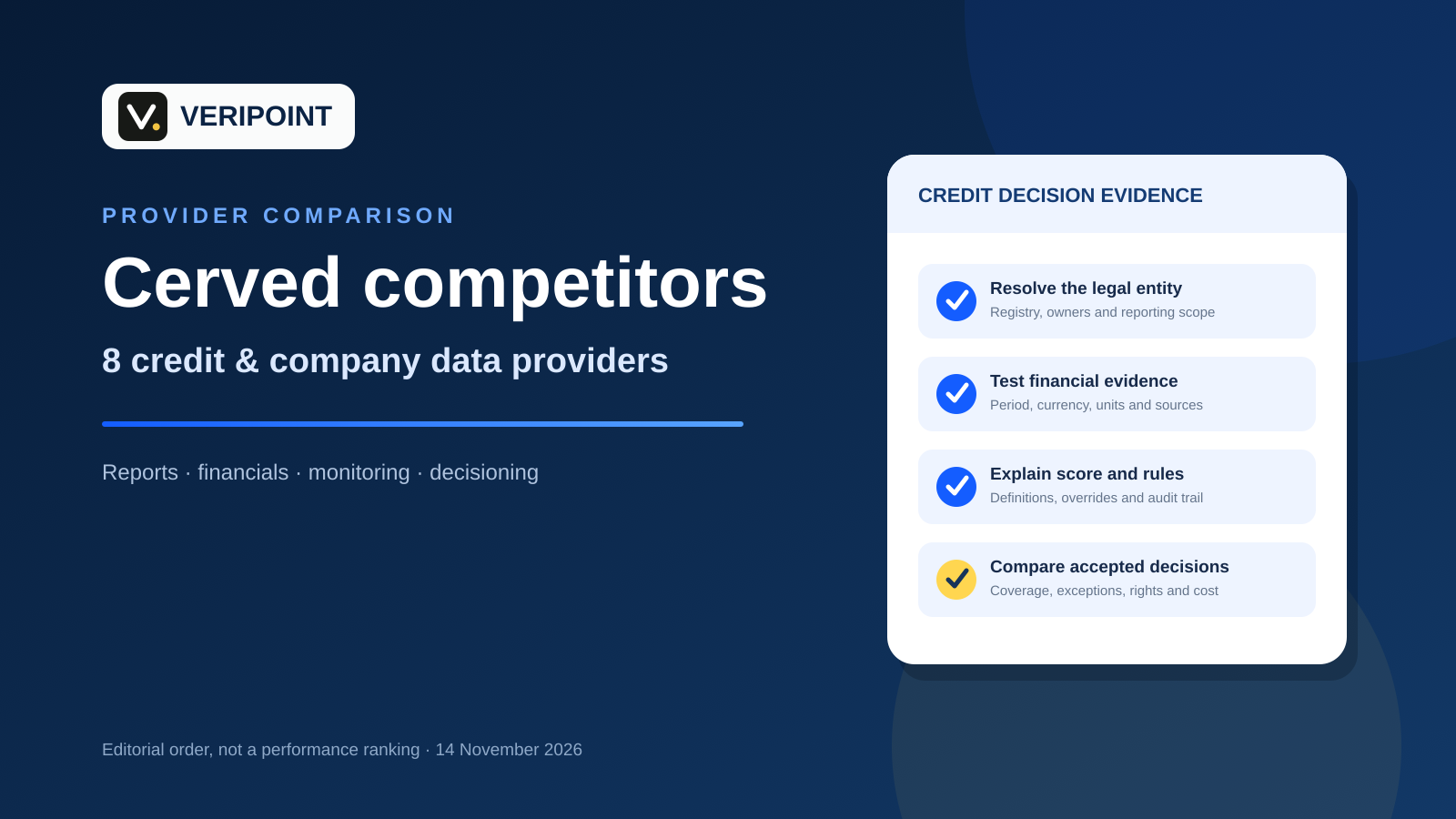
Cerved competitors should be compared against the exact country, evidence layer and decision being bought. Cerved Credit Suite combines Italian business information with financial, payment, relationship, fraud, sustainability and portfolio-risk analysis. Veripoint, Global Database and Monetaiq address narrower company-financial and registry workflows. Dun & Bradstreet, Creditsafe, Coface and CRIF bring different international credit, monitoring and decisioning propositions. The products overlap, but they are not interchangeable.
Choose by evidence and geography, not feature count
Keep Cerved on the shortlist when Italian business information, payment behaviour, connected-company analysis and portfolio credit management are central.
Choose Veripoint for explained analysis when legal entity, period, currency, units, calculations and missing evidence must remain reviewable.
Choose Global Database or Monetaiq when registry-led identity, ownership, filed accounts or normalized financial delivery is the primary requirement.
Shortlist Dun & Bradstreet or Creditsafe for multinational commercial-credit reports, monitoring and portfolio workflows.
Shortlist Coface when payment experience, credit recommendations and a possible path to separate trade-credit insurance matter.
Shortlist CRIF when business information must connect to country-specific bureau data, fraud controls or automated decisions.
Commercial disclosure: Veripoint is by Global Database. Monetaiq’s legal footer identifies Global Data Intelligence Limited, the same company behind Global Database. They are affiliated products with different workflows, not three independent endorsements. The order follows this series’ editorial format and is not an objective ranking or independent product test.
Compare the shortlist
Choose by data, workflow and cost. The order is editorial, not a performance ranking. Select a provider to read the full review.
| Provider / focus | Strengths | Limitations | Pricing | Best for |
|---|---|---|---|---|
| CervedItalian business information, credit-risk analytics, monitoring and credit-management workflow | Credit Suite brings company, financial, payment, relationship and risk information into one credit-management environment rather than requiring a separate report for every step. | Cerved’s strongest differentiation is Italian company and credit context; international depth, sources, turnaround and monitoring must be tested country by country. | Quote-based; no public Credit Suite amountChecked 2026-11-14 | Credit managers and finance teams with significant Italian counterparties that need local business information, monitoring and portfolio-risk tools. |
| VeripointEvidence-aware private- and public-company financial research with reviewable analysis | Research keeps entity identity, reporting basis, calculations and missing evidence together instead of reducing the decision to an unexplained score. | Veripoint is not a consumer credit bureau, formal credit-rating agency, debt-collection service or replacement for Cerved’s Italian payment and credit-risk data. | Free; USD 99, USD 199 or USD 499 per monthChecked 2026-11-14 | Finance, lending, investment, procurement and corporate-development analysts who need explained company-financial research with visible evidence boundaries. |
| Global DatabaseRegistry-led legal-entity identity, ownership, filed financials and licensed delivery | Registry-led identifiers and sources help distinguish a parent, subsidiary, branch and similarly named company before financial or credit analysis begins. | Registry and filed-company data do not reproduce Cerved payment pools, formal ratings, fraud tools or collections capabilities. | Regis Free or displayed $99/month; Corporate customChecked 2026-11-14 | Risk, compliance and data teams that need sourced legal-entity, ownership and filed-company evidence with contractually defined delivery rights. |
| MonetaiqNormalized company financial statements, ratios and volume-based API access | The public price page identifies monthly financial-report allowances, so the primary consumption unit is visible before an enterprise sales process. | Normalized accounts do not replace Cerved payment behaviour, fraud signals, credit ratings, collections support or portfolio risk opinions. | Displayed $99, $199, $499 or $999 per monthChecked 2026-11-14 | Research and data teams that mainly need normalized company accounts with visible report-volume economics and API delivery. |
| Dun & BradstreetGlobal business credit data, scores, monitoring, portfolio analytics and decision support | D-U-N-S identifiers and global company linkage can help normalize counterparties and corporate groups across a multinational portfolio. | Global scale does not guarantee identical report fields, payment data, score performance or update timing for every country and legal entity. | Finance Analytics quote-based; separate products have named pricesChecked 2026-11-14 | Multinational credit teams that need global business identifiers, commercial credit information, monitoring and portfolio analytics. |
| CreditsafeBusiness credit reports, monitoring, portfolio tools, APIs and automated decisions | Self-service reports and monitoring support recurring customer, supplier and portfolio checks rather than one-off research only. | Coverage and monitored change types vary by country; an international allowance does not guarantee identical report content or data freshness. | Quote-based packages; current standard amounts not publicChecked 2026-11-14 | Credit and procurement teams that need online business credit reports, monitoring and optional API or decision workflows across multiple countries. |
| Coface Business InformationBusiness credit reports, payment experience, monitoring and trade-credit context | Reports combine company, financial and payment information with a documented score and maximum-credit recommendation for operational credit decisions. | Country coverage is broad but report depth, financial availability, delivery and monitoring can vary by legal entity and jurisdiction. | Subscription credits or per-order quote; public amount unavailableChecked 2026-11-14 | Trade-credit and procurement teams that want reports, payment experience and monitoring with a possible path to separately contracted credit insurance. |
| CRIFBusiness information, country-specific bureau data, decisioning, fraud controls and portfolio risk | Business information sits beside scoring, decision support, fraud and portfolio capabilities, reducing handoffs in complex credit workflows. | Country-specific bureaus, scores, legal rules and product fields are not uniform, so a successful test in one market cannot validate another. | Quote-based globally; regional MyRA plans are separateChecked 2026-11-14 | Banks, lenders, insurers and multinational credit teams that need business information connected to bureau data, fraud, decisioning or portfolio controls. |
Start by separating five company-data categories
Business credit reports are designed for a counterparty decision. Depending on country and product, they can include identity, financials, payment behaviour, legal events, scores, opinions, recommended limits and monitoring. Cerved, Dun & Bradstreet, Creditsafe, Coface and CRIF operate in this layer. The shared label does not guarantee the same sources or model. A score is meaningful only with its scale, reference population, observation date, default definition and treatment of overrides.
Private-company financial platforms begin with a resolved legal entity and the accounts it is required or chooses to file. The critical context is reporting period, filing date, currency, units and standalone or consolidated scope. Veripoint emphasizes explained analysis; Monetaiq emphasizes normalized statements and delivery; Global Database emphasizes registry and ownership evidence. Cerved and the credit providers can include financials, but a credit opinion is not the same as a complete, normalized account history.
Registry data answers whether the entity exists, who controls or manages it, how it is linked and what it has filed. It can be decisive for onboarding, KYB and group mapping, but it is not payment experience or a formal rating. Global Database is the registry-led specialist in this shortlist. D&B’s identifiers and corporate linkage are useful for global normalization. Every provider still needs to prove that the tested record maps to the correct legal entity rather than a trading name or parent.
Decisioning and monitoring systems turn data into rules, alerts, scores, decisions and governed workflows. Cerved, D&B, Creditsafe and CRIF all describe capabilities in this layer, but scope differs. Buyers should test rule versioning, explanations, overrides, permissions, alert definitions, audit logs, model monitoring, integration latency and fallback behaviour. A company-research workspace can supply an input without becoming the system that approves a credit limit.
Formal credit ratings are separate regulated opinions on creditworthiness. Cerved Rating Agency describes itself as an Italian rating agency for non-financial corporates and debt instruments, with solicited and unsolicited services. That is not the same thing as purchasing Credit Suite. Procurement must name the legal entity, methodology, surveillance process and deliverable. A business-information score or recommended limit should never be labelled a formal rating merely because both discuss credit risk.
Public-market terminals and private-capital intelligence solve different problems again. Terminals organize prices, news, estimates, research and trading-related data; private-capital platforms focus on funds, investors, rounds and transactions. They can contain company fundamentals but do not automatically replace commercial credit reports or registry evidence. See the Bloomberg Terminal alternatives and PitchBook competitors guide when those categories are primary.
Eight Cerved competitors reviewed by buyer fit
Official product and pricing pages were checked independently on 14 November 2026. The table and detailed reviews use the identical eight-provider collection and order. Quote-only products remain quote-only. Published amounts apply only to the named product, visible currency, unit and billing basis. A regional CRIF plan, a D&B small-business product or a provider’s API access fee is not presented as the price of a different enterprise service. Unavailable prices are never plotted as zero.
Italian business information, credit-risk analytics, monitoring and credit-management workflow
Cerved
Cerved Credit Suite is the featured platform because it combines company information with credit and fraud risk, payment behaviour, financial analysis, relationship views, sustainability indicators, monitoring, portfolio segmentation and collections support. It is designed to help credit teams assess customers, prospects and suppliers in Italy and abroad. That is broader than a financial database, but different from Cerved Rating Agency, a separately governed credit-rating agency whose formal opinions are not automatically part of a Credit Suite contract.
Strengths
- Credit Suite brings company, financial, payment, relationship and risk information into one credit-management environment rather than requiring a separate report for every step.
- Cerved has substantial Italian business-information depth and supports portfolio analysis with a buyer’s own accounting, exposure and customer data.
- Its 2026 research and product activity includes predictive macroeconomic modelling and analysis of Italian business deterioration, giving buyers current local context for portfolio work.
Limitations
- Cerved’s strongest differentiation is Italian company and credit context; international depth, sources, turnaround and monitoring must be tested country by country.
- Credit Suite information, Cerved Rating Agency opinions and Cerved credit-management services are distinct propositions and should not be treated as one bundled product.
- The reviewed Credit Suite page does not publish a standard currency amount, user or report unit, billing period or contract term.
- Pricing
- Quote-based; no public Credit Suite amount The official Credit Suite page routes buyers to a demonstration or offer request. It does not publish a standard currency, named-user or report amount, billing period or term. A Cerved catalogue page for the named integrated commercial-information product also did not expose a current price list when checked. Require users, countries, reports, payment data, monitoring population, portfolio analytics, integrations, collections support, implementation, tax, renewal and exit terms in a dated proposal.Pricing checked 2026-11-14.
- Best for
- Credit managers and finance teams with significant Italian counterparties that need local business information, monitoring and portfolio-risk tools.
Evidence-aware private- and public-company financial research with reviewable analysis
Veripoint
Veripoint is a focused company-research workspace for resolving a legal entity, retrieving available financial and ownership records, comparing periods and producing explained analysis. It is relevant when a Cerved buyer mainly needs a reviewable company-financial answer rather than an Italian credit bureau, formal rating or collections platform. The workflow keeps reporting period, filing date, currency, units, accounting scope, calculations and evidence limitations beside the conclusion, making the output easier to review and challenge.
Strengths
- Research keeps entity identity, reporting basis, calculations and missing evidence together instead of reducing the decision to an unexplained score.
- Available private- and public-company records can be investigated in one workflow, with mismatched periods or scopes preserved as limitations.
- Published monthly plans and a Free tier allow a controlled pilot with representative companies before higher-volume provider data or custom delivery is added.
Limitations
- Veripoint is not a consumer credit bureau, formal credit-rating agency, debt-collection service or replacement for Cerved’s Italian payment and credit-risk data.
- Available statements, ownership and history depend on the exact entity, jurisdiction, filing regime and underlying source publication.
- Workspace subscriptions do not automatically include direct-provider APIs, bulk raw data, redistribution rights or every original filing.
- Pricing
- Free; USD 99, USD 199 or USD 499 per month Prices are USD before tax, billed monthly: Pro includes 100 completed searches, Business 300 and Enterprise 1,000. Annual charges are USD 1,009.80, USD 2,029.80 and USD 5,089.80 after the published 15% annual discount. Free includes three completed searches per day. Business and Enterprise add daily monitoring for up to 25 and 100 companies. Direct data APIs, bulk files and custom feeds are separately scoped.Pricing checked 2026-11-14.
- Best for
- Finance, lending, investment, procurement and corporate-development analysts who need explained company-financial research with visible evidence boundaries.
Registry-led legal-entity identity, ownership, filed financials and licensed delivery
Global Database
Global Database connects company identity, registry evidence, directors, shareholders, corporate groups, filed financials and enterprise delivery through Regis, its wider platform, APIs and bulk services. It is relevant when a Cerved comparison is primarily about confirming the counterparty, mapping ownership or obtaining a contractually defined company dataset. The public Regis proposition emphasizes sourced registry answers and visible timestamps. That evidence can strengthen a credit file, but it is not the same as Cerved payment behaviour, a rating or a collection service.
Strengths
- Registry-led identifiers and sources help distinguish a parent, subsidiary, branch and similarly named company before financial or credit analysis begins.
- Regis provides sourced company research across identity, available financial, officer, shareholder and group information in one interface.
- Corporate delivery can combine KYB, ownership, directors, financials, linkage, APIs, bulk files and commercial licensing for defined enterprise uses.
Limitations
- Registry and filed-company data do not reproduce Cerved payment pools, formal ratings, fraud tools or collections capabilities.
- Filed accounts, ownership disclosure, original documents and update timing vary by jurisdiction, entity and registry rules.
- The published Regis price is not a quote for Corporate API, bulk delivery, redistribution, unlimited users or every Global Database dataset.
- Pricing
- Regis Free or displayed $99/month; Corporate custom The official Regis page displays Free with five credits per month and Pro at $99 per month, billed monthly, with 200 credits. The page shows a dollar sign without an explicit currency code, so settlement currency and tax must be confirmed. Free and Pro are view-only for CSV/PDF and exclude API access. Corporate downloads, API, bulk delivery, unlimited seats and lookups, redistribution and commercial licensing are quote-based.Pricing checked 2026-11-14.
- Best for
- Risk, compliance and data teams that need sourced legal-entity, ownership and filed-company evidence with contractually defined delivery rights.
Normalized company financial statements, ratios and volume-based API access
Monetaiq
Monetaiq concentrates on structured company accounts: balance sheet, income statement, cash flow, ratios and filing history for private and public companies. It is relevant when the requirement is repeatable financial retrieval for models, screening or an internal workflow rather than Cerved credit-management services. Searches and identifier lookups are free, while an allowance is consumed when a full financial record is retrieved. The defined report unit makes it possible to model cost against a frozen company sample.
Strengths
- The public price page identifies monthly financial-report allowances, so the primary consumption unit is visible before an enterprise sales process.
- Statements and ratios are normalized into a repeatable schema and retain source and filing-date context for available company records.
- Business and Scale add monitoring; bulk statements, original filings, redistribution and higher-volume delivery can be separately scoped.
Limitations
- Normalized accounts do not replace Cerved payment behaviour, fraud signals, credit ratings, collections support or portfolio risk opinions.
- Coverage and history vary by entity and filing regime; one successful company record does not promise every field or year for the next entity.
- The plan cards and detailed table publish different daily API limits, so throughput must be confirmed in writing before purchase.
- Pricing
- Displayed $99, $199, $499 or $999 per month The official page displays Starter, Growth, Business and Scale at $99, $199, $499 and $999 per month with 200, 600, 3,000 and 10,000 financial reports. It advertises 15% off annual billing. The page uses dollar signs without an explicit currency code, so settlement currency and tax must be confirmed. Monthly allowances reset; bulk files, original filings, redistribution and higher limits are separate. Confirm the daily API limit because plan cards and the comparison table conflict.Pricing checked 2026-11-14.
- Best for
- Research and data teams that mainly need normalized company accounts with visible report-volume economics and API delivery.
Global business credit data, scores, monitoring, portfolio analytics and decision support
Dun & Bradstreet
Dun & Bradstreet’s Finance Analytics proposition brings company information, D-U-N-S identifiers, scores, payment insights, monitoring and portfolio analysis into a credit-management workflow. It is relevant when a buyer wants global commercial-credit information and standardized entity identifiers rather than an Italy-first platform. D&B also sells separate small-business products and individual reports. Those public prices cannot be extrapolated to Finance Analytics, which is the enterprise service compared here.
Strengths
- D-U-N-S identifiers and global company linkage can help normalize counterparties and corporate groups across a multinational portfolio.
- Finance Analytics combines credit information, monitoring, portfolio views, decision support and configurable policies for commercial credit teams.
- D&B documents separate analyst, small-business, API and enterprise routes, allowing buyers to scope a product to the actual workflow.
Limitations
- Global scale does not guarantee identical report fields, payment data, score performance or update timing for every country and legal entity.
- A D&B score or recommended limit still requires the buyer’s policy, exposure, security, concentration and current financial evidence.
- Public Credit Insights or one-time report prices do not represent Finance Analytics enterprise pricing, which is not publicly standardized.
- Pricing
- Finance Analytics quote-based; separate products have named prices The official Finance Analytics page offers a trial or sales contact and does not publish a standard currency amount, named-user/report unit, billing period or term. D&B separately displays Credit Insights Basic at USD 49 per month or USD 499 per year and Plus at USD 149 per month or USD 1,499 per year for a business’s own credit profile. Those are named small-business products and are not used as Finance Analytics pricing. Request countries, users, portfolios, monitoring, scorecards, data access, implementation, renewal and exit in a matched quote.Pricing checked 2026-11-14.
- Best for
- Multinational credit teams that need global business identifiers, commercial credit information, monitoring and portfolio analytics.
Business credit reports, monitoring, portfolio tools, APIs and automated decisions
Creditsafe
Creditsafe packages online business credit reports, company monitoring, portfolio analysis and international report access for credit teams. Higher packages add larger allowances, decisioning and API options, depending on market and contract. It is a practical comparison where the buyer needs high-frequency self-service reports and alerts across countries rather than Cerved’s specific Italian depth. Creditsafe’s US package page identifies Standard, Plus and Premier bundles but leaves commercial amounts to a quote.
Strengths
- Self-service reports and monitoring support recurring customer, supplier and portfolio checks rather than one-off research only.
- The product family includes international reports, Connect API and automated decision tools, so screen and integrated workflows can be scoped separately.
- Package pages identify included functions and allowances, helping buyers ask for a matched proposal even though the amounts are not public.
Limitations
- Coverage and monitored change types vary by country; an international allowance does not guarantee identical report content or data freshness.
- Automated decisions require validation of score definitions, rule governance, overrides, audit logs and the buyer’s own policy.
- The reviewed US package page does not publish standard currency amounts, billing periods or contract terms for Standard, Plus or Premier.
- Pricing
- Quote-based packages; current standard amounts not public Creditsafe’s official US page lists Standard, Plus and Premier bundles with reports, monitoring and international allowances but asks buyers to request a quote. No standard USD amount, user/report price, billing period or term was shown. Connect API and automated decision products are separately scoped. Require countries, users, reports, monitoring population, international units, API or decisioning, implementation, support, taxes, renewal and termination in the proposal.Pricing checked 2026-11-14.
- Best for
- Credit and procurement teams that need online business credit reports, monitoring and optional API or decision workflows across multiple countries.
Business credit reports, payment experience, monitoring and trade-credit context
Coface Business Information
Coface Business Information provides Snapshot and Full reports, company identity, available financials, payment experience, a 0–10 score, maximum credit recommendations and monitoring. It draws on information used in Coface’s trade-credit insurance activities, which can be useful for supplier and customer risk. It remains distinct from the insurance policy itself: report access does not transfer insured risk, and a score or recommendation is not a promise that an invoice will be paid.
Strengths
- Reports combine company, financial and payment information with a documented score and maximum-credit recommendation for operational credit decisions.
- Coface’s trade-credit context gives buyers a route from information and monitoring to separately contracted insurance where relevant.
- Business reports can be ordered through a platform or API, supporting both analyst review and integrated workflows.
Limitations
- Country coverage is broad but report depth, financial availability, delivery and monitoring can vary by legal entity and jurisdiction.
- A report, score or maximum-credit recommendation does not provide insurance coverage and must be applied within the buyer’s exposure policy.
- The reviewed public pages explain credits or per-order access but do not publish a universal currency amount, unit price, billing period or contract term.
- Pricing
- Subscription credits or per-order quote; public amount unavailable Coface states that reports and data can be purchased through subscription credits or per order, and that API use itself is free while the underlying reports and data retain their normal cost. The reviewed official pages do not publish one standard currency amount, credit value, report price, billing period or enterprise term. Require countries, report types, monitoring, API, payment experience, users, currency, tax, renewal and reuse rights in writing.Pricing checked 2026-11-14.
- Best for
- Trade-credit and procurement teams that want reports, payment experience and monitoring with a possible path to separately contracted credit insurance.
Business information, country-specific bureau data, decisioning, fraud controls and portfolio risk
CRIF
CRIF combines business information with country-specific bureau operations, analytics, decisioning, fraud controls, open-banking capabilities and portfolio management. Its global business-information service also connects local data capabilities with the SkyMinder platform. CRIF is relevant as a Cerved competitor when the requirement spans several countries or must feed governed decisions. Because CRIF operates different local bureaus and products, buyers must name the market, permissible purpose and data layer instead of assuming one global file.
Strengths
- Business information sits beside scoring, decision support, fraud and portfolio capabilities, reducing handoffs in complex credit workflows.
- A 37-country presence and local information capabilities can support multinational programmes when each market is contracted and tested explicitly.
- CRIF documents APIs, analytics and configurable decisioning in addition to analyst-facing reports and monitoring.
Limitations
- Country-specific bureaus, scores, legal rules and product fields are not uniform, so a successful test in one market cannot validate another.
- Decisioning breadth can add implementation, governance and change-management work that is unnecessary for a team seeking only company accounts.
- The global business-information page does not publish a standard currency amount, user or report unit, billing period or term.
- Pricing
- Quote-based globally; regional MyRA plans are separate CRIF’s global business-information pages route buyers to local or sales channels and publish no standard currency, per-user/report amount, billing period or term. As a named regional example only, ICAP CRIF’s MyRA page displayed Starter at EUR 350 per year, Professional at EUR 600 per year and Enterprise at EUR 1,000 per year, all excluding VAT, with different unit allowances. Those regional subscriptions are not global CRIF tariffs. Require countries, bureaus, reports, users, portfolios, decisions, integrations, support, renewal and termination in writing.Pricing checked 2026-11-14.
- Best for
- Banks, lenders, insurers and multinational credit teams that need business information connected to bureau data, fraud, decisioning or portfolio controls.
Italian credit intelligence is moving toward predictive portfolio management
Cerved’s current product and research activity makes this comparison broader than choosing a static report. On 28 October 2026 Cerved announced a partnership with Fondazione Collegio Carlo Alberto focused on data, research and predictive macroeconomic models. On 2 October, an ABI-Cerved outlook projected Italian company deterioration rates of 2.9% in 2027 and 2.8% in 2028, compared with 2.6% in 2025. Those figures are provider research at a portfolio level, not an assessment of an individual counterparty and not a promise of future defaults.
The practical procurement implication is that credit platforms increasingly connect company evidence to portfolio segmentation, monitoring and decisions. That can reduce manual handoffs, but it magnifies errors. A stale filing, weak entity match or opaque score can move from one analyst’s screen into many automated actions. Buyers need lineage from source to field, field to indicator, indicator to rule and rule to decision. They should be able to reproduce what happened, identify the version in force and preserve the human override.
Cerved’s Credit Suite also illustrates why product boundaries matter. It describes credit and fraud risk, financial and payment analysis, sustainability, relationships and collection support. Cerved Rating Agency separately describes formal rating activity with more than 100 analysts and a regulated methodology. A buyer evaluating a “Cerved alternative” must decide whether the actual requirement is self-service company information, a monitored credit portfolio, a formal rating, decision orchestration or outsourced credit management. No single shortlist is correct for all five.
International providers are developing in parallel. D&B and Creditsafe connect online reports with monitoring and workflow; Coface links business information with its trade-credit context; CRIF spans local bureau, fraud and decisioning capabilities. Registry and financial specialists offer a narrower evidence layer that can be easier to test and integrate. The useful question is not which marketing page lists the most capabilities. It is which provider can produce the required evidence, at the required time, under the required rights for the buyer’s actual population.
Map each provider to the workflow it is built to support
The matrix summarizes documented product emphasis. “Core” means central to the reviewed proposition, “available” means described but dependent on product, country, entity or contract, and “adjacent” means it is not the primary job. It is a category map, not a vendor score, field-level coverage test or claim that similarly labelled cells contain equivalent information.
Eight providers cover different evidence layers
| Provider | Business credit | Private financials | Registry & ownership | Decisioning & fraud | Monitoring |
|---|---|---|---|---|---|
| Cerved | Core | Core | Available | Core | Available |
| Veripoint | Adjacent | Core | Available | Adjacent | Adjacent |
| Global Database | Available | Core | Core | Adjacent | Adjacent |
| Monetaiq | Adjacent | Core | Available | Adjacent | Adjacent |
| Dun & Bradstreet | Core | Available | Core | Core | Available |
| Creditsafe | Core | Available | Available | Core | Available |
| Coface Business Information | Core | Available | Available | Available | Available |
| CRIF | Core | Available | Available | Core | Available |
Use a weighted evaluation model before demonstrations begin
The model below is illustrative. It shows how a procurement team can allocate 100 percentage points before viewing vendor demonstrations. The weights are not vendor scores and do not claim that one provider performs better. A lender may increase decision controls; a procurement team may increase ownership evidence; an Italian wholesaler may raise country and payment-data fit. Freeze the model, test script and required fields first so a persuasive demonstration cannot rewrite the criteria.
Evidence fit should outweigh feature volume
Score only observed results. If an entity cannot be resolved, mark it missing rather than inferring a match. If a financial period is unavailable, do not replace it silently with an older year. If a score cannot be explained, record the definition and documentation gap. Weighting a missing critical control as zero is different from plotting a quote-only price as zero: the first is a documented evaluation rule, while the second would falsely imply that an unknown commercial amount is free.
Model analyst effort separately from subscription price
A quote is only one part of the cost. The illustrative model below assumes 500 company reviews per month and analyst time valued at USD 60 per hour. It compares three hypothetical workflows: 18 minutes per case, 8 minutes per case and 4 minutes per case. The time assumptions are not measured vendor performance and are not assigned to any provider. They exist only to show how a buyer can test whether claimed automation changes total operating cost.
Price the manual work around the data
Manual-heavy review
Baseline analyst effort with no assumed workflow reduction.
150 hours 9,000 USD illustrative analyst costNo avoided effort assumed500 × 18 min ÷ 60Assisted review
Hypothetical reduction after data normalization and defined review rules.
66.7 hours 4,000 USD illustrative analyst cost19% of the bar marks avoided baseline effort500 × 8 min ÷ 60Exception-led review
Hypothetical exception handling after stable automation and controls.
33.3 hours 2,000 USD illustrative analyst cost47% of the bar marks avoided baseline effort500 × 4 min ÷ 60The model should be expanded into a three-year view. Include implementation, data migration, parallel running, report or credit overages, monitored entities, API traffic, local-country charges, analyst investigation, training, support, taxes, annual uplifts and termination assistance. Separate recurring platform fees from third-party data, formal ratings and credit-management services. A lower licence price can be more expensive if analysts spend longer resolving entities or re-keying evidence; a broader platform can be wasteful if its controls are not required.
Run a country-stratified acceptance test
Start with a frozen sample of legal entities, not a list of brand names. Include current customers, prospects, suppliers, subsidiaries, branches, recently incorporated companies, failed entities, thin files, difficult names and deliberate false matches. Stratify the sample by Italy, other core countries and long-tail markets. Record registration number, legal name, country and the expected evidence for each case. Do not let providers substitute easier companies after the test begins.
Give every provider the same tasks: resolve the entity, return available financial periods, identify owners and group relationships, explain the score or recommendation, show payment and adverse information where legally available, create a monitoring event and export or retrieve the result through the proposed delivery method. Record source date, observation period, currency, units, accounting scope, missing fields, latency, analyst corrections and whether the output can be reproduced.
For APIs, test identifiers, schema changes, rate limits, retries, error codes, asynchronous jobs, webhooks, history and backfills. Ask who can store raw fields, create derived scores, use data in models, display it to customers, retain it after termination and resolve corrections. Screen access does not imply API, bulk or redistribution rights. A demonstration of one Italian company also does not prove international depth.
For scoring and decisioning, ask for score definitions, reference populations, validation windows, overrides, rule versioning, adverse-event treatment and model monitoring. Keep a human approval path until thresholds and exceptions have been tested. If a provider also offers insurance, ratings or collections, price and contract each service separately. A report does not transfer risk, a rating is not a credit limit, and collections performance is not proven by the presence of a credit score.
Compare proposals on an identical schedule. Require currencies, taxes, users, reports, credits, monitored companies, countries, integrations, implementation, service levels, support, overages, price uplifts, renewal, data return and deletion. Ask what happens to alerts, audit logs and stored reports after termination. Keep the incumbent during parallel running and define a rollback trigger. Migration is complete only when the new workflow meets acceptance thresholds on real entities and the buyer can evidence the decision process.
Start with representative companies, not a sales demo
Use Veripoint to review available company financials with the legal entity, reporting basis, calculations and evidence limitations kept together. Then compare the result with the credit, rating or monitoring layer your policy actually requires.
Compare plans Open company analysisQuestions buyers ask before a shortlist
01What are the best Cerved competitors?
The best Cerved competitor depends on the evidence and country being replaced. Veripoint fits explained company-financial research; Global Database fits registry identity, ownership and filed evidence; Monetaiq fits normalized statements and report-volume delivery; Dun & Bradstreet and Creditsafe fit multinational commercial-credit workflows; Coface adds payment and trade-credit context; and CRIF combines business information with country-specific bureau, fraud and decisioning capabilities. Cerved remains a strong candidate when Italian business information, payment behaviour and portfolio credit management are central.
02What is the best Cerved alternative for business credit reports?
There is no universal substitute because report fields, payment data, scores and legal access vary by country. Dun & Bradstreet is relevant for global identifiers and commercial credit, Creditsafe for online reports and monitoring, Coface for payment experience and credit recommendations, and CRIF for business information tied to local bureaus and decisioning. Test the same legal entities and require the report date, source chain, score definition, financial period, recommended limit, monitoring rules, delivery time and permitted use.
03How much does Cerved Credit Suite cost?
Cerved did not publish a standard currency amount, named-user or report price, billing period or contract term for Credit Suite on the official pages reviewed on 14 November 2026. Buyers are directed to request an offer or demonstration. A valid proposal should itemize countries, users, report types, payment data, monitored companies, portfolio analytics, integrations, collections support, implementation, tax, renewal and termination. Do not use a separate Cerved product or legacy catalogue price as a Credit Suite tariff.
04What does Cerved Credit Suite do?
Cerved Credit Suite supports the assessment and monitoring of customers, prospects and suppliers. The reviewed product combines company and economic-financial information with credit and fraud risk, payment behaviour, relationships, sustainability indicators, portfolio segmentation and collections support. Teams can add their own accounting and exposure information. Exact documents, indicators and international coverage depend on the contract, country and entity, so a demonstration should use the buyer’s real counterparties.
05Is Cerved Credit Suite the same as Cerved Rating Agency?
No. Credit Suite is a business-information and credit-management platform. Cerved Rating Agency is a separately governed Italian credit rating agency that issues solicited and unsolicited opinions for non-financial corporates and debt instruments under the applicable rating-agency framework. A Credit Suite subscription should not be assumed to include a formal rating, rating surveillance or analyst engagement. Buyers should identify which Cerved legal entity, product, methodology and deliverable is in scope.
06Which Cerved alternative is best for private-company financials?
Veripoint is a focused choice when an analyst needs a reviewable conclusion with the legal entity, reporting period, filing date, currency, units, accounting scope, calculations and evidence gaps kept together. Monetaiq is relevant for normalized financial statements and report-volume API delivery, while Global Database adds registry identity, ownership and filed evidence. No provider can supply accounts that a company was not required to publish, so test exact registration numbers, periods and consolidated or standalone scope.
07How is Cerved different from Dun & Bradstreet?
Cerved is especially strong in Italian business information and credit-management context. Dun & Bradstreet emphasizes global commercial data, D-U-N-S identifiers, linkage, scores, monitoring and portfolio analytics. Both can support business-credit decisions, but country depth, payment data, score scales, identifiers, workflow and contract terms differ. Compare the same Italian and non-Italian entities, then inspect source dates, missing values, linkage accuracy, score explanations, monitored events and manual work rather than comparing brand breadth alone.
08Can Cerved alternatives provide APIs and monitoring?
Several can, but screen access never implies API, bulk, storage or redistribution rights. Global Database offers Corporate API and bulk delivery; Monetaiq publishes report-volume plans and separately scoped bulk files; Dun & Bradstreet, Creditsafe, Coface and CRIF document integrated delivery or decision products; and Veripoint includes workspace API access within plan allowances while direct provider data is separate. Require fields, identifiers, history, refresh, rate limits, retries, storage, derived-data, model-use, audit, security and termination rights in writing.
09Which Cerved competitor is best outside Italy?
The answer depends on where the counterparties are and which data is legally available. Dun & Bradstreet can fit broad multinational commercial-credit and linkage needs, Creditsafe offers online reports and monitoring across many markets, Coface adds payment and trade-credit context, and CRIF combines local operations with international business information. Global Database, Monetaiq and Veripoint address company identity and financial research rather than replacing every local bureau. Run a country-stratified pilot because a provider’s global footprint does not guarantee uniform depth.
10How should a company evaluate Cerved competitors?
Define the decision, countries, data layer and permissible purpose first. Freeze a representative sample containing approved, declined, thin-file, cross-border and deliberately difficult entities. Give every provider the same tasks and record entity-match accuracy, report date, source traceability, missing fields, score meaning, overrides, latency and analyst effort. Compare matched three-year proposals including implementation, monitoring, local-office charges, overages and exit. Keep the incumbent until acceptance thresholds, parallel running, data retention, migration and rollback are proven.
Method: Veripoint reviewed public official product, pricing and 2026 announcement pages on 14 November 2026. Descriptions, country presence and coverage statements are provider claims, not independent tests. Public prices are shown only for the named product, currency and unit. Enterprise or unavailable pricing remains quote-based. Research URLs and keyword evidence are retained privately; no ranking, coverage, savings, search position or inclusion outcome is promised.