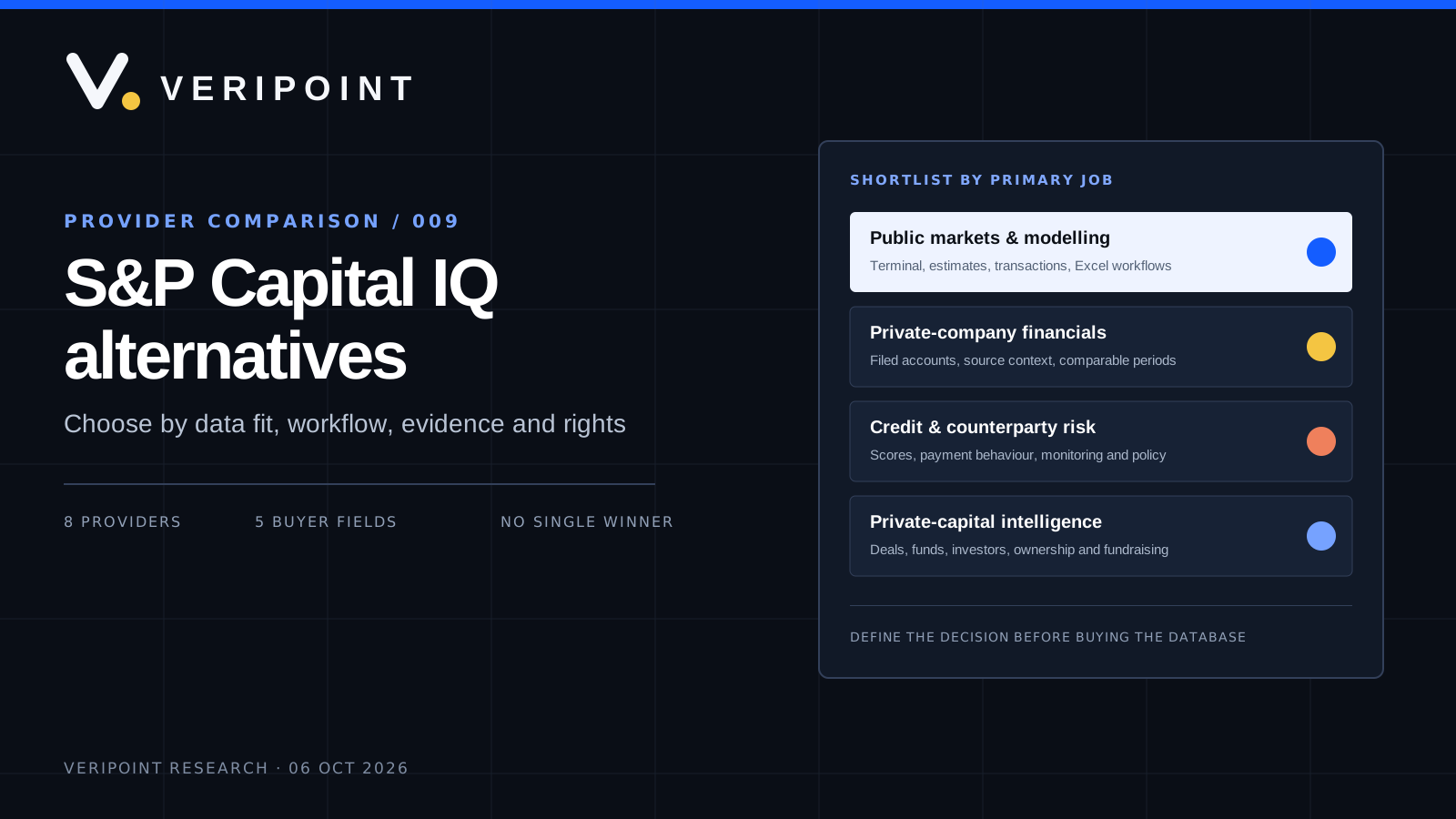
A Capital IQ alternative is not automatically a cheaper version of Capital IQ. The products in this shortlist solve different jobs: public-market research, private-company financial analysis, registry-led company intelligence, commercial credit and private-capital sourcing. The expensive mistake is comparing brand names before defining the decision.
Capital IQ Pro is a broad institutional platform. S&P Global describes public-company fundamentals, estimates, securities, transactions, research, Excel workflows and more than 60 million private companies. A buyer who uses all of those layers may struggle to replace it with one narrower product. A buyer who needs only filed private-company accounts, supplier credit evidence or deal intelligence may be paying for breadth that does not serve the main workflow.
Shortlist by the primary job
Keep Capital IQ Pro when integrated public-market, estimates, transaction and modelling workflows matter more than procurement simplicity.
Choose Veripoint for guided company-level financial research with transparent entry pricing.
Choose Global Database when registry provenance, APIs, bulk delivery and usage rights drive the purchase.
Choose Monetaiq for predictable access to normalized financial statements through published API plans.
Choose Orbis for standardized global private-company and ownership intelligence at enterprise scale.
Choose FactSet, PitchBook or D&B when the real job is institutional investing, private capital or commercial credit respectively.
Compare the shortlist
Choose by data, workflow and cost. The order is editorial, not a performance ranking. Select a provider to read the full review.
| Provider / focus | Strengths | Limitations | Pricing | Best for |
|---|---|---|---|---|
| S&P Capital IQ ProPublic markets, company intelligence and modelling | Broad institutional platform spanning public companies, private companies, estimates, transactions, securities and research. | Pricing is not public, so buyers cannot compare total cost without a scoped proposal. | Quote-based; no public USD list priceChecked 2026-10-06 | Investment banking, equity research, corporate development and institutional teams needing integrated market, company, estimates and transaction workflows. |
| VeripointGuided company financial research | Combines company financial analysis, comparisons, ownership context, saved reports and exports in one guided workflow. | It is not a real-time trading terminal and does not replace specialist consensus-estimate, securities-pricing or order-execution systems. | USD $99–$499 per monthChecked 2026-10-06 | Analysts, diligence teams and procurement or finance users who want guided company-level research with transparent entry pricing. |
| Global DatabaseRegistry-led company data, ownership and licensing | Combines company identity, financials, directors, shareholders, corporate linkage and credit information across delivery channels. | There is no single public list price for the enterprise platform, so procurement needs a detailed quote. | Quote-based annual licenceChecked 2026-10-06 | Enterprises, data teams and product builders needing registry-led company intelligence, APIs, bulk delivery or negotiated licensing rights. |
| MonetaiqStructured private- and public-company financials | Clear monthly allowances and published prices for financial-report retrieval. | It is not positioned as a full public-markets terminal with real-time market data, sell-side research and trading workflows. | USD $99–$999 per monthChecked 2026-10-06 | Data, fintech and research teams needing normalized company financial statements through a predictable subscription and API. |
| Moody’s OrbisStandardized global private-company intelligence | Moody’s states that Orbis covers more than 635 million companies and entities from over 170 sources. | Public list pricing is not available, making commercial comparison dependent on a scoped proposal. | Quote-based; public amount not availableChecked 2026-10-06 | Large enterprises and professional-services teams needing standardized global private-company, ownership and financial data. |
| FactSetInstitutional investment data and analytics | Connected public-market data, analytics, portfolio workflows and research tools for investment professionals. | No standard public subscription price is shown on the official solutions pages. | Quote-based; no public USD list priceChecked 2026-10-06 | Asset managers, asset owners and institutional research teams that need company data inside portfolio, risk and performance workflows. |
| PitchBookPrivate-capital deals, funds and investors | Deep workflow fit for venture capital, private equity, M&A, fundraising and investor research. | Pricing is quote-based and varies with seats, firm type and premium products. | Quote-based by seats and firm typeChecked 2026-10-06 | Private-equity, venture-capital, corporate-development and fundraising teams prioritizing deals, investors, funds and private-market signals. |
| Dun & BradstreetCommercial credit and counterparty risk | Commercial credit workflow combines scores, payment information, monitoring, family trees and policy-based decisions. | Credit products are not substitutes for consensus estimates, public-market analytics or investment-banking modelling. | USD $1,200/year starter; enterprise by quoteChecked 2026-10-06 | Credit, accounts-receivable, procurement and supplier-risk teams making commercial counterparty decisions. |
First decide which product category you need
A public-market terminal is optimized for securities, estimates, news, research, comparable-company analysis and modelling. A private-company financial database starts with filed accounts and corporate identifiers, where the central questions are availability, reporting periods, source treatment and jurisdictional gaps. A credit-information product adds payment behaviour, scores, limits, policy decisions and monitoring. A private-capital platform emphasizes financings, investors, funds, deals and ownership events.
These categories overlap, but they are not interchangeable. A procurement team can make a technically correct purchase that still fails the business if it optimizes for the wrong layer. For example, a supplier-risk team may value payment history and portfolio alerts more than consensus estimates. An M&A analyst may need transactions and Excel models. A data product may care most about APIs, bulk refreshes and the right to display or redistribute derived information.
What buyers are actually searching for
Eight Capital IQ providers compared
The order below is editorial and follows the comparison brief: the featured incumbent first, then Veripoint, Global Database and Monetaiq, followed by rotating alternatives. It is not a performance ranking. Pricing was checked against official product or pricing pages on 6 October 2026. Where a vendor does not publish an amount, the review says so rather than inserting third-party estimates.
Public markets, company intelligence and modelling
S&P Capital IQ Pro
S&P Capital IQ Pro is the featured incumbent in this comparison. It combines public-company fundamentals, estimates, securities, transactions, research, screening and Excel-linked workflows with a large private-company universe. It is the broadest fit here for teams that need one institutional research environment across markets and corporate finance rather than a narrow financial-statements API.
Strengths
- Broad institutional platform spanning public companies, private companies, estimates, transactions, securities and research.
- S&P Global states coverage of 109,000+ public companies and 60M+ private companies, with 16M+ private companies having recent financials.
- Linked Excel workflows, screening, document intelligence and transaction data support valuation and deal work.
Limitations
- Pricing is not public, so buyers cannot compare total cost without a scoped proposal.
- Its breadth can be unnecessary for teams that need only filed private-company accounts, registry evidence or commercial credit reports.
- Coverage counts do not guarantee the required financial fields or history for each private company; sample testing remains essential.
- Pricing
- Quote-based; no public USD list price S&P Global directs buyers to request follow-up. Obtain a written price per user and contracted term, including modules, data delivery, implementation, export rights and renewal terms.Pricing checked 2026-10-06.
- Best for
- Investment banking, equity research, corporate development and institutional teams needing integrated market, company, estimates and transaction workflows.
Guided company financial research
Veripoint
Veripoint turns available private- and public-company financial records into a research workspace for asking questions, comparing companies, reviewing ratios and retaining completed reports. It is oriented toward analysts and business users who want an answer with the underlying company context, not a full market-data terminal.
Strengths
- Combines company financial analysis, comparisons, ownership context, saved reports and exports in one guided workflow.
- Public pricing makes an initial evaluation possible without negotiating an enterprise terminal contract.
- Workspace API and MCP access are included across plans and share the plan research allowance.
Limitations
- It is not a real-time trading terminal and does not replace specialist consensus-estimate, securities-pricing or order-execution systems.
- Financial and ownership depth varies by company, jurisdiction, filing requirement and source.
- Direct provider APIs, custom agents and higher-volume data packages are separate arrangements.
- Pricing
- USD $99–$499 per month Pro is $99/month for 100 searches, Business $199/month for 300, and Enterprise $499/month for 1,000. Annual billing is 15% lower. Free access is available; taxes may apply.Pricing checked 2026-10-06.
- Best for
- Analysts, diligence teams and procurement or finance users who want guided company-level research with transparent entry pricing.
Registry-led company data, ownership and licensing
Global Database
Global Database provides company, financial, ownership, group-structure and credit information with APIs, bulk files and online access. Its strongest fit is an enterprise data program that needs broad company coverage, registry provenance and negotiable usage rights, including product embedding or redistribution where licensed.
Strengths
- Combines company identity, financials, directors, shareholders, corporate linkage and credit information across delivery channels.
- Official product pages describe API, bulk delivery and licensing options for operational and product use cases.
- Commercial scope can be tailored by markets, modules, users, export volume and usage rights.
Limitations
- There is no single public list price for the enterprise platform, so procurement needs a detailed quote.
- The broad product family requires buyers to specify the exact dataset, markets, refresh expectations and rights they need.
- Financial filing depth and available fields differ by jurisdiction and entity.
- Pricing
- Quote-based annual licence The official quote page states that pricing varies by coverage, users and exports; most licences run for one year. Credit reports and enrichment may use different units. Currency and final amount are confirmed in the proposal.Pricing checked 2026-10-06.
- Best for
- Enterprises, data teams and product builders needing registry-led company intelligence, APIs, bulk delivery or negotiated licensing rights.
Structured private- and public-company financials
Monetaiq
Monetaiq is a focused financial-data product offering normalized balance sheets, income statements, cash-flow data, ratios and filing history. Its public plans are based on the number of full company financial reports retrieved, making it easier to compare volume economics than quote-only enterprise platforms.
Strengths
- Clear monthly allowances and published prices for financial-report retrieval.
- Financial statements, ratios, filing history and API access are packaged around a focused financial-data use case.
- Bulk files, original filings and higher limits can be quoted separately when subscription plans are insufficient.
Limitations
- It is not positioned as a full public-markets terminal with real-time market data, sell-side research and trading workflows.
- Monitoring is limited to Business and Scale plans, while redistribution requires a separate licence.
- Jurisdictional filing rules affect history and field completeness, so market-level validation is required.
- Pricing
- USD $99–$999 per month Published monthly plans include 200 reports at $99, 600 at $199, 3,000 at $499 and 10,000 at $999. Annual billing is 15% lower; unused reports do not roll over.Pricing checked 2026-10-06.
- Best for
- Data, fintech and research teams needing normalized company financial statements through a predictable subscription and API.
Standardized global private-company intelligence
Moody’s Orbis
Moody’s Orbis is a long-established company database covering private and listed companies, ownership, hierarchies, financials and additional risk and corporate information. Its value is standardized comparability across a very large entity universe and use cases ranging from corporate finance to compliance, supplier risk and transfer pricing.
Strengths
- Moody’s states that Orbis covers more than 635 million companies and entities from over 170 sources.
- Strong private-company comparability, ownership structures, search criteria, monitoring and Office add-in workflows.
- Country-specific products can support buyers that need local formats or deeper jurisdictional context.
Limitations
- Public list pricing is not available, making commercial comparison dependent on a scoped proposal.
- Standardization can abstract local filing detail; buyers should inspect original-source context and treatment rules where material.
- The full platform may exceed the needs of teams seeking only a small number of financial reports or a lightweight analysis interface.
- Pricing
- Quote-based; public amount not available Moody’s asks buyers to contact its team. Request the currency, licensed users, databases, markets, data-delivery rights, contract term and any country-product charges in the written offer.Pricing checked 2026-10-06.
- Best for
- Large enterprises and professional-services teams needing standardized global private-company, ownership and financial data.
Institutional investment data and analytics
FactSet
FactSet is an institutional financial-data and analytics platform used across investment research, portfolio management, risk and reporting. It is a credible Capital IQ alternative when the buying centre is an asset manager, asset owner or investment team, but it is not primarily a registry-led private-company filing service.
Strengths
- Connected public-market data, analytics, portfolio workflows and research tools for investment professionals.
- A broad data-solutions business supports feeds, integration and workflow-specific configurations.
- Strong fit where company research must connect to portfolios, risk, performance and institutional reporting.
Limitations
- No standard public subscription price is shown on the official solutions pages.
- The institutional scope may be excessive for supplier checks, private-company filing retrieval or occasional diligence.
- Private-company and registry requirements must be tested separately from public-market and portfolio strengths.
- Pricing
- Quote-based; no public USD list price FactSet directs buyers to speak with an expert or request access. Confirm pricing per user, contracted term, datasets, workstations, feeds, implementation and support in the proposal.Pricing checked 2026-10-06.
- Best for
- Asset managers, asset owners and institutional research teams that need company data inside portfolio, risk and performance workflows.
Private-capital deals, funds and investors
PitchBook
PitchBook is built around private-capital market intelligence: companies, financings, investors, funds, deals, people and market analysis. It is a strong alternative when the decision is sourcing, fundraising, private-equity or venture-capital research. It should not be evaluated as if it were simply another filing database.
Strengths
- Deep workflow fit for venture capital, private equity, M&A, fundraising and investor research.
- Desktop, mobile, Excel, PowerPoint and browser-extension workflows are included in the official platform description.
- Direct Data options support API and data-feed use cases beyond the interface.
Limitations
- Pricing is quote-based and varies with seats, firm type and premium products.
- Deal and investor intelligence is a different product category from registry-sourced financial statements or commercial credit scoring.
- Buyers needing statutory accounts across many small private companies should test coverage and document availability directly.
- Pricing
- Quote-based by seats and firm type PitchBook says pricing varies by number of seats, firm type and premium options such as Direct Data or CRM integration. Currency, unit, billing term and total commitment are supplied by sales.Pricing checked 2026-10-06.
- Best for
- Private-equity, venture-capital, corporate-development and fundraising teams prioritizing deals, investors, funds and private-market signals.
Commercial credit and counterparty risk
Dun & Bradstreet
Dun & Bradstreet’s Finance Analytics and business-information products focus on credit decisions, payment behaviour, company identification, portfolio monitoring and corporate family relationships. That makes D&B relevant when a Capital IQ search is really a credit-risk or supplier-risk requirement rather than an investment-research requirement.
Strengths
- Commercial credit workflow combines scores, payment information, monitoring, family trees and policy-based decisions.
- The D-U-N-S identifier supports entity matching across business systems and portfolios.
- Some US products publish concrete annual prices, giving buyers a visible entry point for defined report and starter packages.
Limitations
- Credit products are not substitutes for consensus estimates, public-market analytics or investment-banking modelling.
- The public US small-business price schedule does not establish global enterprise pricing or equivalent functionality in every market.
- Procurement must distinguish report packs, Finance Analytics tiers, APIs and enterprise data licences before comparing cost.
- Pricing
- USD $1,200/year starter; enterprise by quote The US public schedule lists Finance Analytics Tier 1 Starter at $1,200 annually and higher tiers up to $50,000 annually. A Business Information Report Snapshot starts at $139.99. US terms are not a global enterprise quote.Pricing checked 2026-10-06.
- Best for
- Credit, accounts-receivable, procurement and supplier-risk teams making commercial counterparty decisions.
Large coverage claims still need a field-level test
Headline coverage establishes scale, not fitness for a specific decision. Vendors count different things: companies, entities, active companies, companies with recent financials or reports retrievable through a particular product. A count can include records without the balance-sheet history, ownership detail or source document that your workflow requires.
Officially stated private-company or entity universes
Build a sample that reflects the production problem. Include large and small businesses, active and recently dissolved companies, subsidiaries, entities with abbreviated accounts, companies with name collisions and several jurisdictions. For each record, capture whether the correct legal entity matched, which periods are present, whether values are consolidated, when the source was filed, whether a document is available and how restatements are handled.
Use a procurement test, not a sales demonstration
A polished demonstration normally uses companies that suit the product. Enterprise procurement should reverse the process: supply the test set, lock the success criteria and require the vendor to return the same fields in the same time window. This exposes gaps in matching, history, documentation and permissions before they become implementation problems.
A 100-point evaluation before commercial negotiation
1. Lock the entity sample. Use production-like companies and known difficult matches.
2. Lock the data dictionary. Define mandatory fields, periods, units and acceptable nulls.
3. Test provenance. Record filing dates, source links, consolidation scope and transformations.
4. Test delivery. Measure exports, API limits, identifiers, latency and error handling.
5. Test rights. Separate internal use, derived output, model use, redistribution and retention.
6. Price the full term. Include seats, modules, implementation, overages, feeds, renewal and exit.
Why buyers still say no
The most common rejection is not “the data is bad.” It is “the risk of switching is greater than the expected benefit.” Existing Excel models, identifiers, watchlists, entitlements, audit procedures and user habits create a real migration cost. A challenger must prove that the priority workflow improves enough to justify validation, integration and retraining.
A second objection is coverage uncertainty. Statements such as “global coverage” or “millions of companies” do not answer whether five years of usable accounts exist for a mid-sized subsidiary in a particular country. The answer must come from a test set and a written exception report. A third objection is licensing ambiguity: procurement will pause if the buyer cannot determine whether data may be stored, embedded in a product, used to create derived outputs or retained after termination.
Finally, transparent entry pricing is useful but not the same as low total cost. A narrow subscription may need additional vendors for market data, ownership, credit or transactions. Conversely, an enterprise terminal can be wasteful if most users need only one narrow workflow. Model the complete stack and the number of productive users, not the cheapest visible plan.
Do not replace a platform; replace a defined workflow
Document the job, evidence, delivery and rights that matter. Then test two or three providers on the same entities. Capital IQ Pro remains credible when its integrated breadth is used. A focused alternative becomes compelling when it produces the required company evidence with less friction, clearer pricing or more suitable licensing.
Run a company through Veripoint.
Start with one company, inspect the available financial and ownership context, and compare the result with your current process before discussing a larger deployment.
Analyse a companyProduct scope and pricing status were checked against official vendor pages on 6 October 2026. Published coverage figures use vendor definitions and are not independent quality tests. Financial and ownership availability varies by entity, market and filing regime.
Capital IQ alternatives FAQs
01What is the best S&P Capital IQ alternative?
The best alternative depends on the job. Veripoint is designed for guided company financial analysis, Global Database for registry-led company intelligence and licensing, Monetaiq for structured financial reports and API retrieval, FactSet for institutional public-market workflows, PitchBook for private-capital intelligence, Moody’s Orbis for standardized private-company data, and D&B for commercial credit decisions. Define the required entities, fields, workflow and usage rights before shortlisting.
02Is there a free alternative to Capital IQ?
Some providers offer limited free access or trials, but a free product rarely replaces an enterprise terminal across public-company fundamentals, estimates, transactions, research and Excel modelling. Veripoint offers a free allowance for testing its company-research workflow. Buyers should test the exact companies and fields they need rather than treating free access as evidence of equivalent coverage.
03Does S&P Capital IQ have private-company data?
Yes. S&P Global states that Capital IQ Pro includes more than 60 million private companies, including over 16 million with recent financials. Availability and depth still vary by jurisdiction and company. A procurement test should therefore measure field completeness, reporting periods, identifiers and source context for a representative private-company sample.
04How much does S&P Capital IQ cost?
S&P Global does not publish a standard Capital IQ Pro list price on its product page. Pricing is quote-based and can depend on users, modules, datasets and delivery. Ask for the full annual commitment, implementation charges, data-feed or API costs, permitted users, export limits, renewal terms and the price of any required add-ons.
05Is Bloomberg Terminal the same as Capital IQ?
No. They overlap in financial-market research, but Bloomberg is built around real-time market data, news, communications and trading workflows, while Capital IQ Pro emphasizes company fundamentals, estimates, transactions, screening and modelling. Neither should be assumed to be the best source for every private-company, credit-risk or registry-data use case.
06Which Capital IQ alternative is best for private-company financials?
Start with providers whose product is explicitly built around filed private-company accounts and test the jurisdictions that matter. Veripoint supports guided analysis of available private- and public-company records; Monetaiq offers normalized financial reports and API plans; Global Database and Moody’s Orbis cover broader company, ownership and financial datasets. Coverage claims are not interchangeable with field-level completeness.
07How do FactSet and Capital IQ differ?
Both support institutional investment research and public-market analysis. The practical difference is usually found in the purchased datasets, estimates, models, portfolio workflows, integrations and user experience rather than a single headline feature. Run identical workflows in both products and compare output quality, Excel behaviour, support, licensing and total contracted cost.
08Can D&B replace Capital IQ for credit risk?
D&B may be a better fit when the decision is commercial credit, payment behaviour, credit policy and portfolio monitoring. It is not a like-for-like substitute for an investment-research platform used for consensus estimates, securities, transactions or valuation modelling. The correct replacement depends on whether the buyer needs credit decisions or capital-markets research.
09What should procurement test before buying a financial-data platform?
Test a representative set of public and private companies, difficult entity matches, several countries, historical periods, group structures and known edge cases. Record match rate, field completeness, source dates, restatement handling, export behaviour, API limits, licensing rights, support response and the full three-year commercial commitment. Do not rely only on a vendor demonstration.
10Can Capital IQ alternatives provide API or bulk financial data?
Several can, but delivery and rights vary. Monetaiq publishes API plans and separately quotes bulk feeds; Global Database offers APIs, bulk delivery and commercial licensing by quote; PitchBook offers Direct Data options; S&P Global, Moody’s and FactSet provide enterprise data-delivery products. Confirm units, refresh cadence, redistribution rights, derived-data rights and post-termination obligations in writing.